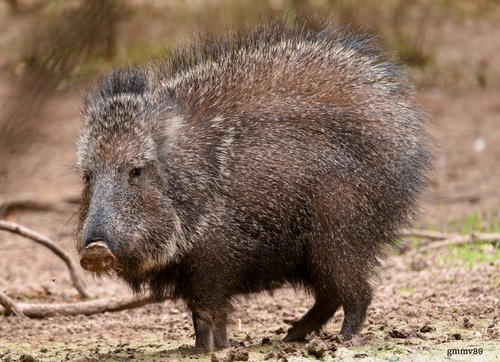
Chacoan Peccary
Catagonus wagneri
Once known only from fossils and thought to be extinct, the Chacoan Peccary is the ultimate survivor of the South American scrublands. This rare, cactus-eating mammal is a prize find for any wildlife observer.
Quick Identification
Size
Length of 96-117 cm (38-46 in); weight typically between 30-43 kg (66-95 lbs)
Colors
Bristly brownish-gray fur with a faint, light-colored collar across the shoulders and darker fur along the spine
Key Features
- Long, flexible snout with a cartilaginous disc
- Distinctive long ears and a tail longer than other peccary species
- Three toes on the hind feet (other peccaries have two)
- Large, specialized nasal chambers for dry environments
When You’ll See Them
Geographic range
Where Does the Chacoan Peccary Live?
Native to the South American continent, the Chacoan Peccary is a highly localized specialist of the Gran Chaco region. Its entire global range is restricted to the semi-arid lowlands where the borders of western Paraguay, southeastern Bolivia, and northern Argentina meet. Because it is so specifically adapted to this harsh, thorny environment, it is not found anywhere else on Earth, and there are no introduced populations outside of its native scrublands.
Basemap © OpenStreetMap contributors
Behavior
Chacoan peccaries, locally known as taguá, are highly social and intelligent mammals that live in small, tightly-knit groups of two to ten individuals. Unlike their more common relatives, they are primarily diurnal, concentrating their activity in the cooler hours of the morning and late afternoon to avoid the punishing heat of the Gran Chaco. They communicate through a series of vocalizations and scent marking; they possess a large dorsal gland on their back which they rub against trees or fellow group members to reinforce social bonds and mark territory.
These animals are notoriously wary and elusive, a trait that helped them remain hidden from science as a living species until 1974. When threatened, they are surprisingly fast and will disappear into the thickest, thorniest brush imaginable. They are also known to be more aggressive than other peccaries when cornered, using their sharp canines for defense. Within their group, they exhibit cooperative behaviors, such as communal dust bathing and huddling together to rest.
EverydayEarth exclusive
Camera Tips
Capturing the rare Chacoan Peccary on camera requires patience and strategic placement within their very specific habitat. Look for 'taguá tunnels'—small, cleared paths through dense, thorny brush that show signs of recent use. Position your camera at a height of approximately 18 to 24 inches (45-60 cm) off the ground. Because they are shorter than deer but stockier than small predators, this mid-low angle ensures you capture the full body and the identifying dorsal gland on their lower back.
Since these animals are extremely sensitive to human presence and strange lights, it is highly recommended to use a 'No-Glow' or high-end black infrared flash. Standard LEDs or white flashes will likely spook the entire group, and they may avoid that specific trail for several weeks afterward. Set your camera to a 3-photo burst or a 20-second video mode. Chacoan peccaries travel in single-file lines; a single photo might only catch the nose of the leader or the tail of the last individual, whereas a video will capture the social dynamics of the whole group.
In the dry season, the best locations for camera traps are near remaining water holes or mud wallows. These are magnetic for peccaries, who use the mud to cool down and protect their skin. If you can find a 'rubbing tree'—a tree at the edge of a trail with smooth, stained bark at peccary height—this is a prime spot, as they frequently stop there to deposit scent. Avoid placing cameras in wide-open areas, as these elusive mammals prefer the security of the thicket.
Similar Species
Species that look similar or are commonly confused with Chacoan Peccary.
Frequently Asked Questions
Record Chacoan Peccary at your habitat
Connect a camera to start building your own species record — AI identifies every visitor automatically.