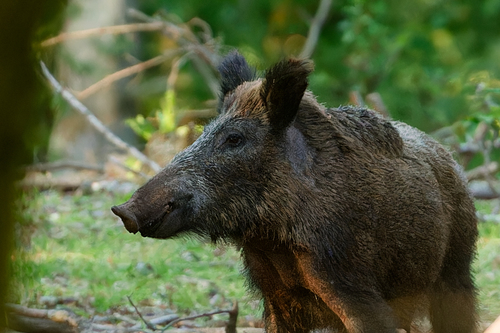
Wild Boar
Sus scrofa
The Wild Boar is a master of survival and the rugged ancestor of our domestic pigs. Intelligent, social, and incredibly adaptable, these powerful foragers are a fascinating sight to capture on camera as they navigate the forest floor.
Quick Identification
Size
90–200 cm (35–79 in) in length; weighing between 60–200 kg (130–440 lbs) depending on region and sex.
Colors
Coarse bristles ranging from dark grey and black to reddish-brown; piglets are born with distinctive light-colored horizontal stripes for camouflage.
Key Features
- Large, wedge-shaped head with a mobile, cartilaginous snout
- Upward-curving tusks in males used for defense and digging
- Straight tail with a tufted end that hangs down
- Stocky, muscular build with a thick neck and short legs
When You’ll See Them
Geographic range
Where Does the Wild Boar Live?
Native to a massive expanse of Eurasia and North Africa, the Wild Boar is one of the most widely distributed mammals in the world. Its original territory stretches from Western Europe and the Mediterranean through the Middle East into India, China, and Japan. Beyond their native lands, they have been introduced to North and South America, Australia, and many island nations, where they have established thriving, often invasive populations in diverse climates ranging from semi-arid plains to temperate mountains.
Basemap © OpenStreetMap contributors
Behavior
Wild Boars are highly social and intelligent mammals, typically organized into maternal groups called "sounders." These groups consist of several related females and their young, while adult males remain solitary for most of the year, only seeking out sounders during the breeding season. They are famous for their "rooting" behavior, using their powerful snouts to turn over large patches of earth in search of food, which plays a significant role in forest soil aeration but can be destructive to gardens.
While naturally shy of humans, boars are remarkably adaptable and have learned to thrive in human-altered landscapes. In areas with high human activity, they often shift their behavior to become almost exclusively nocturnal to avoid detection. They are also excellent swimmers and surprisingly fast runners, capable of reaching speeds up to 40 km/h (25 mph) when threatened.
EverydayEarth exclusive
Camera Tips
To capture the best footage of Wild Boars, mount your camera lower than you would for deer. Aim for roughly knee-height—about 24 to 30 inches from the ground. This lower angle provides a better view of their facial features, tusks, and rooting behavior, rather than just showing their backs. Look for game trails characterized by overturned soil or "rub trees" where boars have scraped their muddy sides against the bark; these are high-traffic areas for your lens.
Boars are creatures of habit and are highly attracted to water and mud. If you have a natural spring, pond edge, or even a low-lying muddy spot (a "wallow"), this is the perfect place for a camera. They use wallows to cool down and protect their skin from parasites. During hot summer months, a camera aimed at a wallow is almost guaranteed to capture social interactions as the sounder gathers to bathe.
Because boars often travel in large groups, avoid using a long trigger interval. Set your camera to take a burst of 3-5 photos or a 15-20 second video. A single photo will often capture the lead sow but miss the dozen piglets following behind. Additionally, use a "No-Glow" infrared flash if possible; while boars aren't as skittish as some predators, they are intelligent and can become "camera shy" if they notice a visible red glow or a bright white flash at night.
If you are in an area where it is legal and safe to attract them, boars have an incredible sense of smell. They are highly attracted to fermented scents. Old corn soaked in water and sugar (sour mash) or fallen apples will draw them in from a distance. However, be mindful that attracting boars can lead to property damage, so place your camera and any attractants well away from your home's foundation or decorative landscaping.
Similar Species
Species that look similar or are commonly confused with Wild Boar.
Frequently Asked Questions
Record Wild Boar at your habitat
Connect a camera to start building your own species record — AI identifies every visitor automatically.