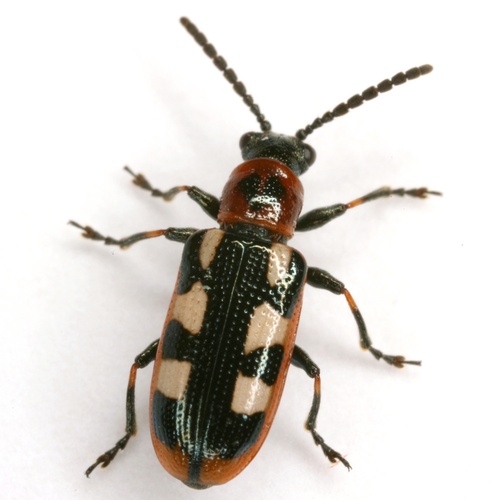
Common Asparagus Beetle
Crioceris asparagi
The Common Asparagus Beetle is a striking, jewel-like specialist of the garden. With its vibrant red borders and creamy spots, this tiny insect is a master of camouflage within its favorite vegetable patch.
Quick Identification
Size
6.0 mm to 9.5 mm (0.24 to 0.37 inches) in length
Colors
Metallic blue-black body with a reddish-orange thorax and wing margins; elytra feature six cream-to-yellow rectangular spots
Key Features
- Elongated metallic blue-black body
- Reddish-orange thorax and outer wing borders
- Six distinct cream or yellow spots on the back
- Larvae are plump, slate-gray grubs with black heads
When You’ll See Them
Geographic range
Where Does the Common Asparagus Beetle Live?
Native to Europe and temperate Asia, the Common Asparagus Beetle has successfully followed its host plant across the Atlantic to become a widespread resident of North America. It is now found throughout the United States and southern Canada, essentially anywhere that asparagus is cultivated. Because of its extreme dietary specialization, its range is strictly limited to regions where its host plant can survive the winter.
Basemap © OpenStreetMap contributors
Behavior
The Common Asparagus Beetle is a highly specialized insect that spends its entire life cycle in close proximity to asparagus plants. Adults emerge from their overwintering sites in early spring, often hiding in garden debris or the hollowed-out remains of old asparagus stalks. Once the first spears begin to poke through the soil, the beetles emerge to feed and lay their dark, oval eggs in neat rows along the plants.
These beetles are primarily active during the day and are most easily spotted when they are basking in the sun on the tips of asparagus spears. They exhibit a distinct defense mechanism: when they feel threatened by a predator or a curious gardener, they will quickly move to the opposite side of the stem or drop to the ground and 'play dead' in the soil until the danger has passed.
EverydayEarth exclusive
Camera Tips
Capturing the Common Asparagus Beetle requires a specialized setup because of their diminutive size. Standard trail cameras usually lack the macro capabilities needed for such small subjects, so using an AI-powered camera with a macro lens or a high-resolution close-up mode is essential. Mount your camera on a stable tripod or a flexible arm specifically targeting the upper third of an asparagus spear or the dense foliage of the ferns, as this is where the beetles spend the majority of their time.
Lighting is critical for bringing out the metallic blue-black sheen and the vibrant red borders of their shells. Position your camera so that it catches the soft morning or late afternoon sun; direct midday sun can cause harsh reflections off their shiny elytra that might blow out the detail in your images. If your camera allows for manual focus, set it to the distance of the plant and wait for the beetles to crawl into the frame rather than relying on autofocus which might get confused by the thin, feathery asparagus leaves.
Because these beetles are attracted to the plant itself, no additional bait is necessary. However, you can increase your chances of a successful 'capture' by identifying plants that already have the dark, pill-shaped eggs attached to them. This indicates a high-traffic area for adults. Set your camera to take short, high-resolution video clips or rapid-fire bursts to catch the beetles as they move around the plant or exhibit their characteristic 'dropping' behavior when a larger insect or bird approaches.
Similar Species
Species that look similar or are commonly confused with Common Asparagus Beetle.
Frequently Asked Questions
Record Common Asparagus Beetle at your habitat
Connect a camera to start building your own species record — AI identifies every visitor automatically.