Spotted Asparagus Beetle
Crioceris duodecimpunctata
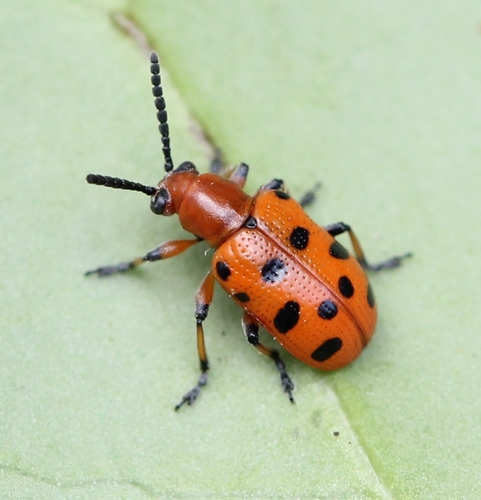
Often mistaken for a ladybug at a distance, the Spotted Asparagus Beetle is a vibrant, 12-spotted jewel of the summer garden. While a specialized feeder, its bright orange hue and shy personality make it a rewarding find for any backyard naturalist.
Quick Identification
Size
5.0 to 6.5 mm (approx. 0.20 to 0.25 inches) in length
Colors
Bright orange to reddish-orange wing covers with 12 distinct black spots; black head, antennae, and legs
Key Features
- 12 black spots arranged in two rows of six on orange wing covers
- Elongated oval body shape typical of leaf beetles
- Black antennae and legs contrasting with orange thorax
- Larvae are orange-yellow and reside inside asparagus berries
When You’ll See Them
Behavior
The Spotted Asparagus Beetle is a specialized leaf beetle that spends its entire life cycle in close proximity to asparagus plants. Unlike many other garden insects that move between various host plants, this species is highly selective. Adults emerge from their overwintering spots in late spring, usually just as the asparagus spears are being harvested. They are known for being quite shy; if they detect a person or a predator, they will quickly scuttle to the opposite side of the stem or drop to the ground to hide in the soil.
While they are technically garden pests, their behavior is less destructive than their relative, the Common Asparagus Beetle. The Spotted variety prefers to wait until the asparagus plants have grown into tall, feathery fronds and produced berries. They are most active during the warmest parts of the day, darting between stems in search of mates or egg-laying sites. Their flight is rapid and direct, making them a challenge to spot mid-air, but they are easy to observe once they settle on a plant to feed.
EverydayEarth exclusive
Camera Tips
To successfully capture the Spotted Asparagus Beetle on a backyard camera, you must focus your efforts on the "ferning" stage of the asparagus plant. Once the harvest is over and the plants grow into 3-5 foot tall feathery bushes, they become magnets for these beetles. Position your camera about 6 to 12 inches away from a cluster of developing green berries. This is the 'hot spot' for the Spotted variety, as females are biologically driven to find these berries to lay their eggs. Use a macro lens attachment if your camera supports it, as these beetles are only about the size of a grain of rice.
Lighting is your best friend when photographing this species. Their orange wing covers have a slight sheen that can cause glare in direct, harsh noon sunlight, but they are also most active when it is hot. For the best results, set your camera to face north or south to avoid direct lens flare, and aim for the 2:00 PM window when the beetles are most mobile. If your camera has a high-speed trigger, use it—these insects are surprisingly fast when they move between branches. Avoid placing the camera where it will cast a shadow over the plant, as the sudden change in light will cause the beetles to drop to the ground in a defensive 'play dead' maneuver.
For the best AI detection, ensure there is high contrast between the beetle and the background. Since the beetle is bright orange and the plant is bright green, the AI usually has an easy time, but busy backgrounds can confuse the sensors. Try to frame your shot so the asparagus frond is backed by a dark mulch or a shaded area of the garden. If you aren't seeing any beetles, look for small, dark entrance holes in the asparagus berries; this is a surefire sign that larvae are present and adults are likely nearby. Set your camera to record short video clips rather than still photos to capture their interesting 'shuffling' walk and the way they use their antennae to sense the plant surface.
Similar Species
Species that look similar or are commonly confused with Spotted Asparagus Beetle.
Frequently Asked Questions
Record Spotted Asparagus Beetle at your habitat
Connect a camera to start building your own species record — AI identifies every visitor automatically.