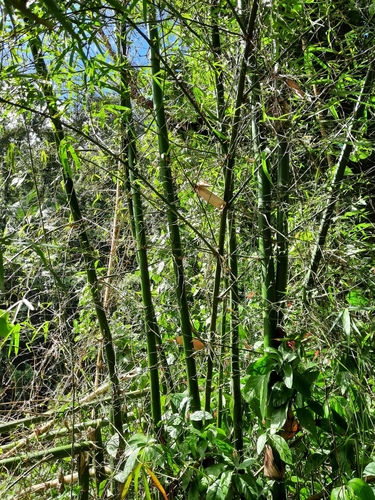
common bamboo
Bambusa vulgaris
The world's most recognizable giant grass, common bamboo brings a touch of the tropics to any landscape with its golden-striped stems and rustling canopy. A fast-growing marvel, it provides essential shelter for backyard birds and a stunning subject for time-lapse photography.
Quick Identification
Size
Height of 10–20 m (33–66 ft); culm diameter of 4–10 cm (1.5–4 in)
Colors
Bright green to lemon-yellow stems, often with dark green longitudinal stripes; foliage is deep green
Key Features
- Open-clump growth habit (non-invasive)
- Thick-walled, hollow woody stems (culms)
- Lance-shaped leaves up to 30cm long
- Nodes are slightly swollen with prominent leaf scars
When You’ll See Them
Geographic range
Where Does the common bamboo Live?
Common bamboo is native to the tropical and subtropical regions of Southeast Asia, Southern China, and the Indian Subcontinent, with high concentrations in countries like India, Thailand, and Vietnam. However, it has been widely introduced and naturalized across the globe, flourishing in the Caribbean, Central and South America, and parts of tropical Africa. It is a staple of lowland landscapes, rarely found in high-altitude mountain ranges but dominating riverbanks and coastal plains.
Basemap © OpenStreetMap contributors
Behavior
Common bamboo is an open-clumping species, meaning it grows in organized groups rather than spreading aggressively like 'running' bamboo varieties. It is one of the fastest-growing plants on the planet, capable of reaching its full height in just one growing season under ideal conditions. While it is a grass, its woody stems provide structural complexity to landscapes, often acting as a natural windbreak or privacy screen.
In the wild and in backyard settings, common bamboo serves as a vital 'vertical forest.' It provides nesting sites for various bird species and a complex architectural environment for arboreal mammals and insects. Unlike many other bamboos, Bambusa vulgaris rarely flowers; when it does, it may happen at intervals of several decades, often followed by the death of the individual clump.
EverydayEarth exclusive
Camera Tips
While plants don't move like animals, capturing common bamboo on your backyard camera offers a unique opportunity for time-lapse photography. Set your camera to take a still image every hour to document the incredible speed of new shoots (culms) emerging from the ground during the wet season. You’ll be amazed to see them grow several inches in a single day.
Because bamboo clumps are dense, they are favorite hiding spots for birds and small mammals. Position your camera at a 45-degree angle pointing toward the base of the clump or a 'wildlife trail' leading into the stalks. Use a high-sensitivity trigger setting, as the movement of birds within the foliage can be subtle. If you are using a trail camera with video capability, the sound of the wind whistling through the bamboo leaves provides a tranquil, high-quality audio backdrop.
Pay attention to lighting. The yellow culms of the 'Vittata' variety can be highly reflective. If your camera uses a powerful infrared flash at night, it might 'white out' the image if placed too close to the stalks. Position the camera at least 10–15 feet away to allow the IR light to spread evenly. In the daytime, the dappled light filtering through the canopy can create high-contrast shadows; setting your camera to HDR mode (if available) will help balance these harsh light changes.
Lastly, consider the 'sway factor.' Bamboo moves significantly in the wind. To avoid hundreds of 'false triggers' caused by moving branches, use the 'Zone Masking' feature on your AI camera to ignore the upper foliage and focus the trigger zone on the ground or the main structural trunks where animals are more likely to pass.
Similar Species
Species that look similar or are commonly confused with common bamboo.
Frequently Asked Questions
Record common bamboo at your habitat
Connect a camera to start building your own species record — AI identifies every visitor automatically.