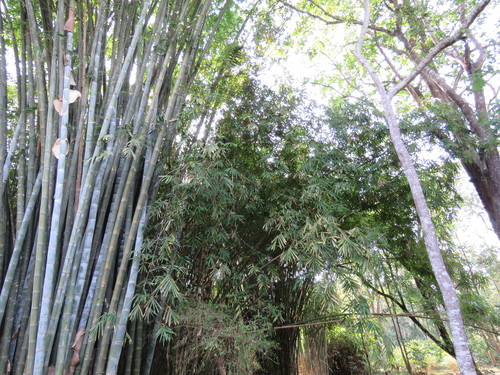
Giant Bamboo
Dendrocalamus giganteus
The undisputed titan of the grass family, Giant Bamboo can grow over a foot in a single day, reaching heights that rival forest trees. Its massive, waxy blue canes create a prehistoric atmosphere in any landscape they inhabit.
Quick Identification
Size
Height: 25–35 m (82–115 ft); Culm diameter: 15–30 cm (6–12 in); Leaves: 15–45 cm (6–18 in) long
Colors
Dull green to bluish-green culms with a powdery-white waxy coating when young; brownish-purple culm sheaths
Key Features
- Massive, thick-walled culms reaching up to 12 inches in diameter
- Distinctive powdery white/blue waxy bloom on young canes
- Large, persistent papery brown culm sheaths with wavy blades
- Dense, non-invasive clumping growth habit
- Broad, lance-shaped leaves with prominent veins
When You’ll See Them
Geographic range
Where Does the Giant Bamboo Live?
Native to the lush, humid regions of mainland Southeast Asia, the Giant Bamboo finds its ancestral home in Myanmar, Thailand, and the Yunnan province of southern China. It thrives primarily in tropical and subtropical climates where rainfall is abundant. Due to its utility and ornamental beauty, it has been widely introduced and naturalized across the Indian subcontinent, Madagascar, and parts of the Americas, particularly in Brazil and the humid coastal regions of the United States like Florida and Hawaii.
Basemap © OpenStreetMap contributors
Behavior
Giant Bamboo is an extraordinary example of nature’s architectural prowess, holding the title as one of the largest bamboo species on Earth. Unlike 'running' bamboos that spread uncontrollably via underground rhizomes, this species is a 'clumper' (pachymorph), meaning it grows in tight, predictable circles. This makes it a favorite for large-scale landscaping and sustainable timber production, as it stays where it is planted while producing an enormous amount of biomass.
The growth behavior of this species is nothing short of cinematic. During the peak of the rainy season, new shoots can emerge from the ground and grow at a rate of nearly 12 to 16 inches per day. As these culms reach their full height, they provide a massive vertical habitat for various wildlife. While it does not 'behave' in the sentient sense, its rapid transformation of the landscape creates immediate microclimates, providing shade, windbreaks, and nesting structures for dozens of bird and insect species.
In human contexts, Giant Bamboo has been a cornerstone of Southeast Asian culture for millennia. Its thick walls and immense strength make it a primary material for construction, scaffolding, and even musical instruments. Because it flowers very rarely—often in cycles of 40 to 80 years—it relies heavily on vegetative growth, making the preservation of existing clumps vital for local ecosystems.
EverydayEarth exclusive
Camera Tips
Capturing the majesty of Giant Bamboo requires a different approach than filming mobile wildlife. To truly showcase its 'giant' nature, place your camera at a low angle near the base of a new shoot. Using a wide-angle lens is essential; otherwise, you will only capture a featureless green pole. If your camera supports time-lapse mode, this is the ultimate way to document Giant Bamboo. Set the camera to take one photo every hour during the monsoon season; when played back, you will see the bamboo visibly 'jump' out of the ground, a spectacular sight that standard video misses.
Because the canopy of a bamboo grove is very dense, light levels at the base can be quite low even during the day. Ensure your camera's ISO settings are set to auto or slightly higher to prevent grainy images. If you are looking to capture the animals that live within the bamboo, aim your camera at the 'nodes' (the rings on the cane) about 5-6 feet off the ground. Many lizards, tree frogs, and insects use these horizontal ridges as resting spots or hunting grounds. Small birds often glean insects from the culm sheaths, so focusing on these textured areas can yield high-quality wildlife shots.
Don't forget the audio! If your camera has a sensitive microphone, it can capture the eerie, melodic 'groaning' and 'clacking' of the massive culms rubbing against each other in the wind. This sound is iconic to bamboo forests and adds a professional layer to your wildlife footage. For the best results, secure the camera to a tripod or a neighboring tree rather than the bamboo itself, as the bamboo can sway significantly in the wind, leading to nauseating motion blur.
Finally, consider the season. The best time to film is at the start of the rainy season when the shoots are emerging. These shoots are covered in fine, dark hairs and look like giant asparagus spears. Position your camera about 3 feet away from a fresh bud in the soil. Within two weeks, that bud will be taller than you are, providing a fantastic narrative arc for your backyard nature documentary.
Similar Species
Species that look similar or are commonly confused with Giant Bamboo.
Frequently Asked Questions
Record Giant Bamboo at your habitat
Connect a camera to start building your own species record — AI identifies every visitor automatically.