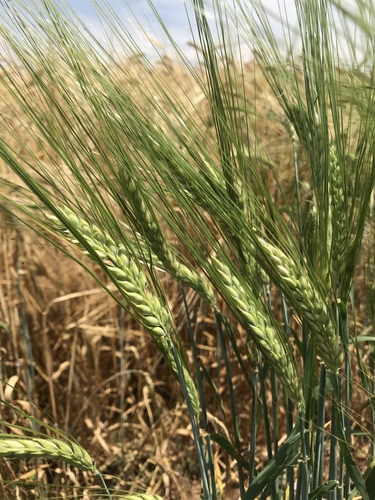
Common Barley
Hordeum vulgare
A cornerstone of human civilization, Common Barley is a resilient and beautiful cereal grain known for its distinctive 'bearded' appearance and golden summer waves.
Quick Identification
Size
Stands 60–120 cm (24–47 in) tall with leaves 10–25 cm (4–10 in) long
Colors
Bright green during the growing season, maturing to a golden-yellow or pale straw color; some heirloom varieties may show dark purple or black husks.
Key Features
- Long, stiff bristles (awns) extending significantly from the seed head
- Spikelets arranged in three-set clusters along the central stem
- Flat, narrow leaves with prominent, clasping auricles at the base
- Upright, hollow stems with distinct nodes
When You’ll See Them
Geographic range
Where Does the Common Barley Live?
Originally domesticated in the Fertile Crescent of the Middle East nearly 11,000 years ago, Common Barley is now one of the most widely distributed cereal grains on Earth. It thrives across the temperate regions of Europe, North America, and Northern Asia, with significant production centers in Russia, Canada, and Germany. Because it is highly adaptable to soil salinity and drought, it also maintains a strong presence in the arid landscapes of North Africa and the high-altitude regions of the Himalayas.
Basemap © OpenStreetMap contributors
Behavior
Common Barley is an annual grass that follows a predictable seasonal rhythm, germinating in either spring or fall depending on the variety. Unlike many wild plants, barley has been selectively bred for thousands of years to be 'non-shattering,' meaning the seeds remain attached to the stalk rather than dispersing naturally. This trait makes it an ideal subject for observation, as the grain heads remain intact long after they have reached maturity.
While it may seem stationary, barley exhibits a beautiful responsiveness to its environment. In a light breeze, barley fields perform a rhythmic 'waving' motion, a phenomenon that has fascinated naturalists for centuries. It interacts with the local ecosystem by providing a massive source of high-energy food for migratory birds and small mammals, while its root system helps stabilize soil and recycle nutrients during its short but vigorous life cycle.
EverydayEarth exclusive
Camera Tips
To capture the majestic beauty of Common Barley on a backyard or trail camera, focus on the movement. Set your camera to a video or high-speed burst mode during the daylight hours when the wind is most active. Placing the camera at a low angle, roughly 12-18 inches from the ground, allows you to look up through the stalks, highlighting the intricate, hair-like awns against the sky. This 'worm’s-eye view' creates a dramatic, forest-like perspective of the crop.
If you are using an AI-powered camera to monitor wildlife, barley is an excellent 'lure' plant. Position your camera facing a patch of barley during the late summer months when the grain is ripe. This is the best time to capture footage of granivorous birds like sparrows and finches, or mammals like rabbits and deer that come to forage. Use a side-lighting angle during the morning (6-9 AM) to illuminate the golden husks and any morning dew clinging to the awns.
For a unique perspective, try a time-lapse setting. By securing your camera to a sturdy T-post or fence lime and capturing one frame every few hours, you can document the 'senescence' of the barley—the magical transition from deep emerald green to a shimmering harvest gold. Ensure your camera is in a waterproof housing and has a clear line of sight, as the rapidly growing stalks can eventually obscure the lens if the camera is placed too close to the center of the patch.
Similar Species
Species that look similar or are commonly confused with Common Barley.
Frequently Asked Questions
Record Common Barley at your habitat
Connect a camera to start building your own species record — AI identifies every visitor automatically.