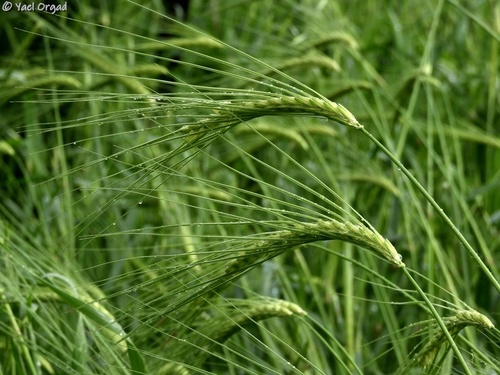
wild barley
Hordeum spontaneum
The ancient wild ancestor of modern cereal crops, wild barley is a hardy Mediterranean grass known for its long, shimmering bristles and vital role in supporting backyard biodiversity.
Quick Identification
Size
Stands 30-70 cm (12-28 inches) tall; seed spikes are 5-10 cm (2-4 inches) long excluding the bristles.
Colors
Bright green during growth, maturing to a golden-straw or pale tan color; awns (bristles) often have a silvery or purplish sheen when young.
Key Features
- Two-rowed seed spikes with long, stiff awns (bristles)
- Brittle rachis that causes the seed head to shatter easily at maturity
- Upright, slender stems with narrow, flat leaf blades
- Rough-textured 'whiskers' designed to latch onto animal fur
When You’ll See Them
Geographic range
Where Does the wild barley Live?
Wild barley is native to Western Asia and the Eastern Mediterranean, with its historical heartland centered in the Fertile Crescent. Its core range encompasses Israel, Jordan, Turkey, Iraq, and Iran, stretching eastward into Afghanistan and Central Asia. It has also naturally expanded across North Africa and into parts of Southern Europe, including Greece and Italy, where it thrives in semiarid and temperate regions.
Basemap © OpenStreetMap contributors
Behavior
Wild barley is a resilient annual grass that follows a strictly seasonal lifecycle synchronized with the Mediterranean climate. It germinates rapidly after the first significant autumn or winter rains, spending the cooler months developing a robust root system and lush green foliage. Unlike domesticated barley, which has been bred to keep its seeds on the stalk for easy harvesting, wild barley is 'spontaneous.' Its most defining behavior is its self-dispersal mechanism: as the seeds ripen, the central stalk of the ear becomes extremely brittle and shatters, dropping the grains to the ground.
In the wild, these plants often grow in dense, monotypic stands, creating a swaying sea of gold by late spring. While it doesn't move in the way animals do, it is a highly 'social' plant in the ecosystem, serving as a primary foundation for the food web. It provides essential cover for ground-nesting birds and a high-calorie feast for rodents and granivorous birds. Because it thrives in disturbed soils, it is frequently one of the first species to colonize fallow fields or garden edges, acting as a pioneer species that stabilizes the soil.
EverydayEarth exclusive
Camera Tips
Capturing the beauty of wild barley with a trail camera requires focusing on the life that lives within it. For the best results, mount your camera on a low-profile stake or a small tripod just 12 to 18 inches off the ground. Angle the lens slightly upward to catch the 'golden hour' light filtering through the long, translucent awns. This low perspective also places you at the eye level of the many birds and small mammals that visit the plant to feed, providing a much more intimate look at the ecosystem than a downward-facing mount.
Because wild barley moves significantly in the wind, it can easily trigger PIR sensors and fill your SD card with empty 'ghost' videos. To prevent this, place your camera in a spot where the barley is the middle-ground subject rather than being directly in front of the lens. Alternatively, use a time-lapse mode during the day (one photo every 5-10 minutes) to capture the plant's growth and the ripening process from green to gold without being overwhelmed by motion-triggered clips.
Late spring is the 'prime time' for wild barley photography. As the seeds mature but before they shatter, the stalks become a magnet for wildlife. Position your camera near a dense patch and you are likely to capture finches, sparrows, and even partridges performing acrobatic feats to reach the seed heads. If your camera has a macro or close-focus setting, use it to highlight the serrated texture of the awns, which are stunning when covered in morning dew or frost.
Similar Species
Species that look similar or are commonly confused with wild barley.
Frequently Asked Questions
Record wild barley at your habitat
Connect a camera to start building your own species record — AI identifies every visitor automatically.