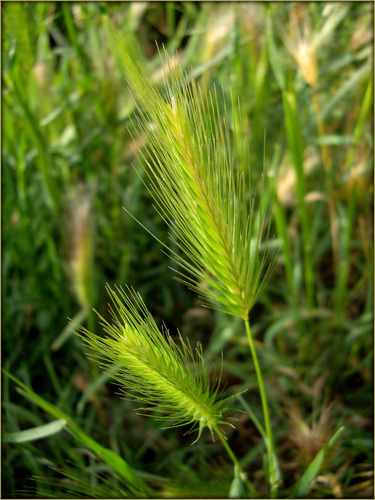
wall barley
Hordeum murinum
A resilient master of the urban landscape, wall barley turns sidewalk cracks and garden edges into miniature golden forests. Known for its hitchhiking seeds and striking bristly texture, this common grass is a fascinating hidden gem of backyard biodiversity.
Quick Identification
Size
Height of 10-40 cm (4-16 inches); flower spikes 5-12 cm (2-5 inches) long.
Colors
Bright green during spring growth, maturing to a golden straw-yellow or pale tan in summer.
Key Features
- Dense, bristly flower spikes resembling miniature ears of corn
- Long, stiff bristles (awns) that point upward and catch the light
- Flattened flower heads that break into segments when ripe
- Hairy lower leaf sheaths and prominent auricles at the leaf base
When You’ll See Them
Behavior
Wall barley is a hardy annual grass known for its opportunistic growth in the 'forgotten' spaces of our environment. It is a pioneer species, often the first to colonize disturbed ground, cracks in the pavement, or the base of sunny walls. Unlike many garden plants, it thrives on neglect and high-nitrogen soils, often benefiting from the nutrient-rich runoff found in urban settings. Its life cycle is rapid: it germinates in the cooler months, explodes into green growth in spring, and sets its iconic bristly seeds by early summer.
The most notable 'behavior' of this grass is its ingenious method of seed dispersal. Each seed is equipped with long, barbed awns that act like biological Velcro. These barbs allow the seeds to hook into the fur of passing mammals or the fabric of human clothing. This ensures the plant's offspring are transported far from the parent plant. While it is a vital part of the urban ecosystem providing cover for insects, its seeds are notorious among dog owners, as they can easily become lodged in a pet's fur, paws, or ears.
EverydayEarth exclusive
Camera Tips
Capturing wall barley on a backyard or trail camera offers a unique opportunity to document the 'micro-wilderness' at your feet. To get the best shots, use a low-profile mount or place your camera directly on the ground. Setting the lens at a height of 5–10 inches and angling it slightly upward will make the grass look majestic and emphasize the intricate texture of the bristly awns against the sky or background foliage.
Because wall barley is highly susceptible to movement in the wind, it is a perfect subject for testing your camera's trigger speed and sensitivity settings. If your goal is to capture wildlife interacting with the plant, place your camera near a dense patch during the seeding phase in early summer. You are likely to film ground-foraging birds like house sparrows or goldfinches searching for seeds, or small mammals like squirrels brushing against the stalks, which provides a great chance to see the seed dispersal mechanism in action.
The secret to stunning wall barley footage is lighting. Utilize the 'golden hour'—the period just after sunrise or before sunset. Position your camera so that the sun is behind or to the side of the grass; this backlighting will catch the long bristles, making the plant appear to glow. If your camera supports time-lapse mode, set it to take one photo every few hours over the course of a month in late spring to create a compelling video of the plant's transition from vibrant green to sun-dried gold.
Similar Species
Species that look similar or are commonly confused with wall barley.
Frequently Asked Questions
Record wall barley at your habitat
Connect a camera to start building your own species record — AI identifies every visitor automatically.