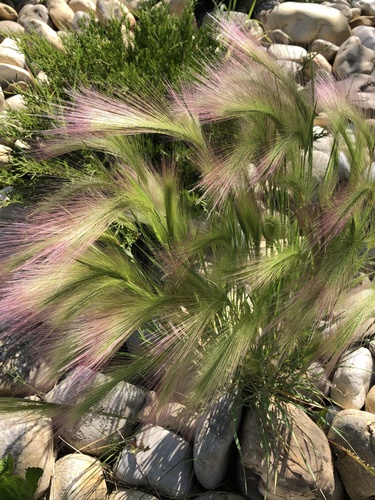
Foxtail Barley
Hordeum jubatum
A shimmering masterpiece of the prairie, Foxtail Barley transforms ordinary backyards into a sea of dancing, iridescent plumes. Its feathery seed heads catch the light like few other plants, offering a hypnotic display of purple and silver.
Quick Identification
Size
12–24 inches (30–60 cm) tall; flower spikes reach 2–4 inches (5–10 cm) in length excluding the long awns.
Colors
Bright green stems; flower heads shimmer with silvery-pink, purple, and cream iridescent hues, maturing to a bleached golden-tan.
Key Features
- Long, feathery awns (bristles) up to 3 inches long that resemble a bushy fox's tail
- Shimmering, iridescent appearance when swaying in the wind
- Clump-forming bunchgrass growth habit
- Awns that spread wide and become brittle as the seed head matures.
When You’ll See Them
Behavior
In a backyard ecosystem, this grass provides essential early-season cover for various beneficial insects and small invertebrates. However, its 'behavior' can be aggressive in garden beds, where it readily outcompetes slower-growing flowers. It is also famous for its mechanical seed dispersal; once the seed heads dry out, they break apart easily, allowing the wind to tumble the 'tails' across the landscape to find new patches of bare soil.
EverydayEarth exclusive
Camera Tips
Because plants are stationary, they provide the perfect subject for time-lapse photography. Set your AI camera to take a photo every 15 to 30 seconds during a breezy afternoon. When played back, the foxtails will look like shimmering waves on the ocean. This is also the best way to document the 'unfolding' of the seed heads, which emerge from their green sheaths over a period of several days in the late spring.
A major tip for trail camera users: Foxtail Barley is a notorious cause of 'false triggers.' If your camera is set to motion-detect mode, the constant swaying of the grass in the wind can fill your SD card with empty videos. Use your camera's 'Zone Masking' feature to exclude the grass from the trigger area, or clear a small patch of ground directly in front of the lens. If you want to capture the grass itself, use 'Time Lapse' mode rather than 'Motion' mode to ensure you get the shots you want without draining your battery on wind-blown movement.
Similar Species
Species that look similar or are commonly confused with Foxtail Barley.
Frequently Asked Questions
Record Foxtail Barley at your habitat
Connect a camera to start building your own species record — AI identifies every visitor automatically.