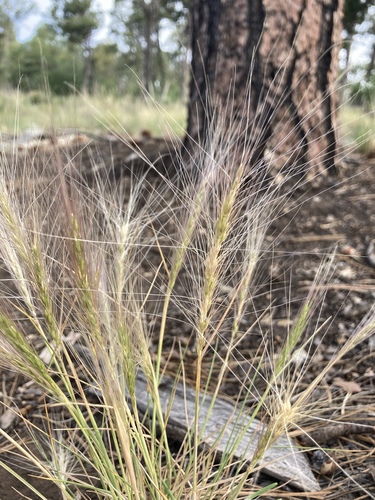
Squirreltail
Elymus elymoides
With its whimsical, bottle-brush seed heads that dance in the prairie wind, Squirreltail is the quintessential grass of the American West. It’s not just a beautiful addition to a backyard; it’s a resilient survivor that provides food and shelter for a variety of wild visitors.
Quick Identification
Size
Stems typically reach 10-45 cm (4-18 inches) in height; seed heads add an additional 5-15 cm (2-6 inches) of length.
Colors
Bright green to silvery-green foliage; seed heads transition from green to a purplish-red or straw-gold as they dry.
Key Features
- Distinctive 'bottle-brush' seed head resembling a squirrel's tail
- Long, stiff bristles (awns) extending 2-10 cm
- Compact, clump-forming bunchgrass growth habit
- Spikelets that break apart easily when mature to aid seed dispersal
When You’ll See Them
Behavior
Squirreltail is a hardy, perennial bunchgrass that plays a vital role as a pioneer species in western landscapes. Unlike many plants that struggle after a disturbance, Squirreltail is often one of the first to recolonize areas affected by wildfire or overgrazing. It grows in tight clumps, sending up stiff, upright stems that culminate in its namesake fuzzy seed heads. While it stays green and succulent during the early spring, it quickly matures and goes dormant during the heat of summer, which is when the seed heads become most prominent and brittle.
In the wild and in backyard habitats, Squirreltail provides essential services to local fauna. During the spring, its tender shoots are a high-protein food source for deer, elk, and small mammals. As the seasons progress and the plant dries out, its dense bunchgrass structure offers perfect nesting cover and thermal protection for ground-nesting birds and reptiles. It is particularly known for its 'competitive' nature against invasive species like cheatgrass, making it a favorite for homeowners looking to restore native balance to their property.
EverydayEarth exclusive
Camera Tips
Capturing the beauty of Squirreltail requires a different approach than filming moving wildlife; your goal is to showcase texture, light, and the visitors the grass attracts. To get the most dramatic shots, position your camera at a low 'worm's-eye' view, roughly 6 to 10 inches off the ground. Angle the lens slightly upward toward the seed heads. This perspective emphasizes the 'squirreltail' shape against the sky and allows you to catch small creatures, like lizards or ground squirrels, as they weave through the stalks.
Lighting is the 'make or break' factor for this species. Place your camera so it is facing toward the sun (backlighting the plant). When the low morning or evening sun hits the long, translucent bristles (awns), they glow with a halo effect that looks stunning on video. If your camera has a 'macro' or 'close-focus' setting, use it to highlight the intricate geometry of the spikelets. Because this grass sways beautifully in the wind, consider using a camera with a high frame rate or a dedicated time-lapse mode to capture its fluid motion over several hours.
While the plant itself is the subject, Squirreltail is a magnet for backyard wildlife. If you are using an AI-powered camera like those from EverydayEarth, set your trigger sensitivity to high. Many birds, such as Finches and Sparrows, will perch on the sturdy stems to feast on the seeds. You don't need bait—the seeds are the lure. However, placing a small, flat rock or a shallow water dish nearby can encourage animals to linger within the frame of the grass, creating a more dynamic 'wildlife-in-habitat' scene.
During the late summer, the seed heads become 'brittle' and shatter to disperse. This is an excellent time to capture 'action shots' of the wind carrying the seeds away. Ensure your lens is clean, as the fine dust from drying grasses can easily smudge the glass. If your camera allows for manual exposure, underexpose slightly to prevent the bright, sun-lit bristles from 'blowing out' or losing detail in the highlights.
Similar Species
Species that look similar or are commonly confused with Squirreltail.
Foxtail Barley
Has longer, more drooping bristles and the seed head does not break apart as easily as Squirreltail.
Bottlebrush Grass
Typically taller and found in more shaded, eastern woodland environments compared to the sun-loving Squirreltail.
Cheatgrass
An invasive annual with drooping, reddish-purple seed heads that lack the upright 'bottle-brush' look.
Frequently Asked Questions
Record Squirreltail at your habitat
Connect a camera to start building your own species record — AI identifies every visitor automatically.