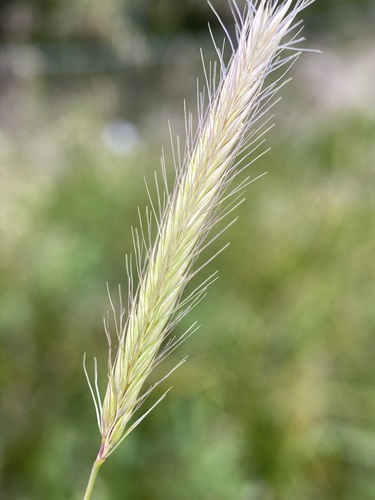
Meadow barley
Hordeum brachyantherum
An elegant, tufted native grass that defines the western landscape, Meadow barley provides vital forage and shelter for a variety of backyard wildlife.
Quick Identification
Size
Grows in tufts 20–100 cm (8–40 inches) tall with seed spikes 2–8 cm (0.8–3 inches) long.
Colors
Bright green to bluish-green foliage; seed heads are green, turning purplish or tan as they mature.
Key Features
- Dense, tufted perennial bunchgrass
- Narrow, bristly flower spikes with slender awns
- Bluish-green leaves that are relatively flat and narrow
- Commonly found in moist, open habitats
When You’ll See Them
Behavior
Meadow barley is a hardy, perennial bunchgrass that plays a vital role in its ecosystem. Unlike the aggressive, invasive barleys often found in disturbed soils, this native species grows in tidy tufts, providing essential structure to North American meadows. It is highly adaptable, capable of thriving in various soil types, including those with high salinity or seasonal flooding.
While it doesn't 'behave' in the animal sense, it interacts dynamically with its environment. It serves as a host plant for several species of butterfly larvae and provides a cooling microhabitat for insects and small amphibians at its base. During the late spring and summer, its bristly seed heads sway prominently in the wind, a motion that often triggers backyard cameras and signals the presence of a healthy, native grassland patch.
EverydayEarth exclusive
Camera Tips
When using an AI-powered camera to capture the life around Meadow barley, placement is key. Because this grass grows in tufts, it creates natural runways for small mammals like voles, shrews, and rabbits. Set your camera on a low mount or a small tripod just 6 to 10 inches off the ground, angled slightly upward toward the seed heads. This perspective allows you to capture both the beautiful texture of the grass and any small wildlife scurrying through the 'forest' of stems.
Be mindful of the wind. The long bristles (awns) on Meadow barley are very sensitive to breezes, which can cause constant false triggers on high-sensitivity settings. To avoid filling your SD card with videos of waving grass, position your camera so the grass occupies the edges of the frame rather than the center, or use a camera with 'zone detection' to ignore the areas where the grass is most active.
Lighting can turn a simple grass profile into a professional-grade shot. Meadow barley is particularly stunning during the 'golden hours' of early morning and late afternoon. The low-angle sun catches the translucent bristles of the seed spikes, making them glow with a halo-like effect. If your camera has manual exposure settings, slightly underexposing can help emphasize this backlighting.
Finally, consider the seasonal transition. In late summer, the seed heads become brittle and attractive to birds like sparrows and finches. Focus your camera on the seed heads during this time to catch 'perch and feed' behavior. If you are trying to attract larger herbivores like deer, place the camera near a larger patch of the grass, as they often graze on the tender green shoots early in the growing season.
Similar Species
Species that look similar or are commonly confused with Meadow barley.
Foxtail Barley
Foxtail barley has much longer, spreading bristles (awns) that give the seed head a bushy, fox-tail appearance compared to the sleeker spikes of Meadow barley.
California Barley
California barley is usually an annual with wider leaves and is more commonly found in drier, upland habitats than the moisture-loving Meadow barley.
Frequently Asked Questions
Record Meadow barley at your habitat
Connect a camera to start building your own species record — AI identifies every visitor automatically.