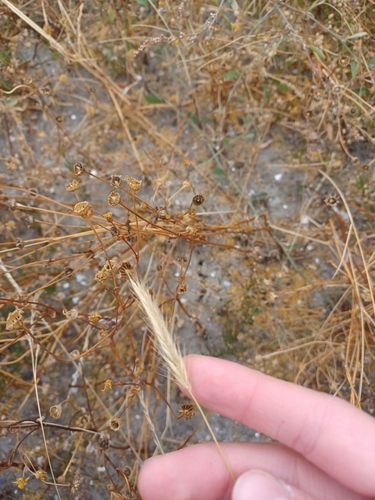
California barley
Hordeum californicum
A graceful, tufted perennial bunchgrass native to the golden hills and coastal prairies of the West. California barley provides essential habitat and a shimmering aesthetic to any native backyard meadow.
Quick Identification
Size
Stems typically reach 20–100 cm (8–40 inches) in height; tufts can spread 15–30 cm (6–12 inches) wide.
Colors
Bright green to glaucous blue-green foliage; flower spikes turn from green to a golden straw-tan as they mature.
Key Features
- Perennial bunchgrass growth habit
- Slender flower spikes 3-9 cm long
- Short, straight awns (bristles) 5-20 mm in length
- Narrow leaves up to 5 mm wide
When You’ll See Them
Geographic range
Where Does the California barley Live?
Native to the western edge of North America, California barley is primarily found throughout the state of California, where it inhabits both coastal and inland regions. Its range extends northward into southern Oregon and southward into the northern reaches of Baja California, Mexico. It is a quintessential component of the Pacific coast's Mediterranean-climate grasslands.
Basemap © OpenStreetMap contributors
Behavior
California barley is a resilient perennial bunchgrass that plays a vital role in the California Floristic Province. Unlike annual grasses that die back completely after seeding, this species remains in a clumping form, often staying green longer into the summer if moisture is available. It is a 'cool-season' grass, meaning its primary growth occurs during the rainy winter and spring months, followed by a period of dormancy or slowed growth during the hot, dry Mediterranean summer.
Ecologically, it serves as an important 'nursery' plant. Its dense tufts provide shelter for small insects and reptiles, while its root system helps stabilize soil and prevent erosion on slopes. It does not spread aggressively through underground runners (rhizomes) but rather expands its clump size over years, making it a well-behaved member of a backyard meadow or native garden.
When it flowers in late spring, the slender spikes dance in the wind, releasing pollen to be carried to neighboring plants. Once the seeds ripen, they become a high-energy food source for various birds and small mammals, linking the plant directly to the local food web.
EverydayEarth exclusive
Camera Tips
Capturing California barley on camera requires a different approach than filming animals. To see the plant at its most dynamic, set your AI-powered camera to a time-lapse mode. Positioning the camera at a low angle (about 12 inches off the ground) during the spring months will allow you to record the 'unfolding' of the flower spikes and the dramatic way the grass heads sway in the wind. Use a tripod or a stable ground mount to avoid camera shake during breezy days.
If your goal is to capture the wildlife that interacts with the grass, place your camera facing a healthy tuft during the early summer when the seeds are ripe. Many ground-feeding birds, such as California Quail or Juncos, will visit the plant to forage. Set your trigger sensitivity to high, as the movement of small birds can be subtle. Ensure the camera is positioned with the sun behind it to illuminate the golden seed heads without causing lens flare.
Seasonal considerations are key. In the winter, the camera can capture the vibrant green 'greening up' phase. In the summer, the straw-colored stalks provide a beautiful, high-contrast backdrop for passing mammals like foxes or coyotes. Avoid placing the camera too close (less than 3 feet) if you lack a macro lens, as the fine details of the awns may blur. For the best results, use a focal setting that keeps the grass in the mid-ground while allowing the background to remain slightly soft.
Similar Species
Species that look similar or are commonly confused with California barley.
Meadow Barley
Meadow barley is also a native perennial but prefers much wetter soils and typically has broader leaves and stouter flower spikes.
Foxtail Barley
Foxtail barley has much longer, more spreading awns (up to 5cm) that create a 'shaggy' appearance, whereas California barley's awns are shorter and more contained.
Wall Barley
Wall barley is an invasive annual grass with much wider, flatter seed heads that break apart easily into sharp segments.
Frequently Asked Questions
Record California barley at your habitat
Connect a camera to start building your own species record — AI identifies every visitor automatically.