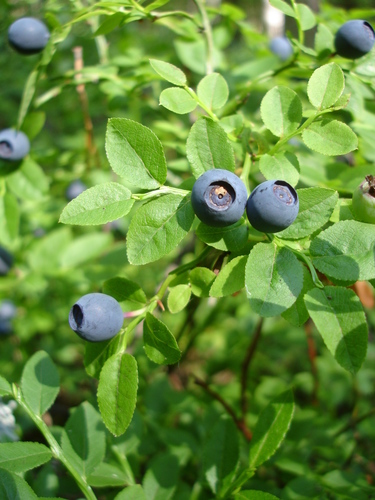
common bilberry
Vaccinium myrtillus
A hidden gem of the acidic woodlands, the common bilberry provides a vital summer feast and stunning autumn colors. Its unique green stems and indigo fruits make it a cornerstone species for backyard naturalists and forest explorers alike.
Quick Identification
Size
Height: 10–60 cm (4–24 in); Leaf length: 1–3 cm (0.4–1.2 in)
Colors
Bright green angular stems; waxy pinkish-white flowers; dark indigo-to-black berries with a blue bloom; scarlet autumn foliage
Key Features
- Photosynthetic green stems that are noticeably angled or 'winged'
- Single or paired nodding, bell-shaped flowers
- Dark berries with red or purple internal flesh
- Small, ovate leaves with finely serrated edges
When You’ll See Them
Geographic range
Where Does the common bilberry Live?
The common bilberry is native to the vast Holarctic region, stretching across much of the Northern Hemisphere. It is most prolific throughout Northern and Central Europe, from the British Isles and Scandinavia down to the Pyrenees and east into the Ural Mountains. Its range extends significantly across Northern Asia and Siberia, while in North America, it is found in specific boreal and montane environments, often thriving where cool temperatures and acidic soils overlap.
Basemap © OpenStreetMap contributors
Behavior
The common bilberry is a resilient, deciduous dwarf shrub that plays a foundational role in many northern ecosystems. Unlike many other plants, it possesses green, angled stems that can perform photosynthesis even when the plant has shed its leaves for winter. This allows it to maximize its energy production in the short growing seasons of northern latitudes and high altitudes. It spreads primarily through an extensive network of underground rhizomes, often forming vast, interconnected colonies that carpet the forest floor.
As a seasonal powerhouse, the bilberry undergoes dramatic changes that dictate the behavior of local wildlife. In spring, its nectar-rich flowers are a vital early resource for bumblebees and other pollinators. By late summer, the production of nutrient-dense berries triggers a feeding frenzy among birds and mammals. The plant is also remarkably hardy, capable of surviving extreme cold under a protective layer of snow, though it is highly sensitive to changes in soil chemistry, requiring acidic conditions to survive.
EverydayEarth exclusive
Camera Tips
Capturing the common bilberry with an AI-powered trail camera is an exercise in low-profile photography. Because these shrubs rarely exceed two feet in height, you should mount your camera on a ground stake or a very low tree trunk, positioning the lens just 6 to 10 inches off the ground. Aiming the camera slightly upward can create a 'forest floor' perspective that highlights the delicate, waxy texture of the spring flowers or the heavy clusters of summer fruit.
While the plant itself is stationary, it acts as a magnet for a variety of wildlife. To capture the best action, set your camera to a high-sensitivity 'Burst' mode or short video clips during the fruiting months of July and August. This is the peak time to see wood mice, bank voles, and various thrushes visiting the patch. If your camera is in a more secluded area, you may even capture larger visitors like deer or black bears foraging on the berries, which are a high-energy food source before winter.
Pay close attention to lighting and seasonal shifts. Bilberries often grow in the dappled shade of coniferous forests, which can lead to overexposed 'hot spots' on sunny days. Position your camera facing north to minimize direct sun glare through the canopy. Don't pack your gear away when the berries are gone; the common bilberry offers one of the most spectacular autumn foliage displays in the forest. Using a time-lapse setting during October can document the leaves turning from green to a brilliant, fiery scarlet, providing some of the most aesthetic footage your backyard camera can produce.
Similar Species
Species that look similar or are commonly confused with common bilberry.
Frequently Asked Questions
Record common bilberry at your habitat
Connect a camera to start building your own species record — AI identifies every visitor automatically.