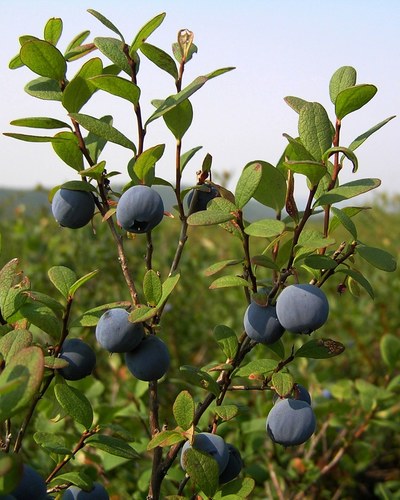
bog bilberry
Vaccinium uliginosum
The Bog Bilberry is the resilient blue jewel of the north, turning acidic wetlands and alpine slopes into a rich feeding ground for bears and birds alike. Its waxy, dusty-blue berries and stunning red autumn foliage make it a seasonal highlight for any backyard or wilderness camera.
Quick Identification
Size
Height of 10–75 cm (4–30 inches); spreading branches can form mats up to 1 metre (3.3 feet) wide.
Colors
Dull blue-green leaves with pale undersides; pinkish-white bell-shaped flowers; dark blue berries with a waxy gray-blue bloom.
Key Features
- Oval, deciduous leaves with visible net-like veins and blunt tips
- Small, drooping clusters of urn-shaped flowers
- Berries with pale greenish-white flesh (unlike the purple flesh of common bilberries)
- Woody, brown stems that are round rather than angled
When You’ll See Them
Geographic range
Where Does the bog bilberry Live?
The bog bilberry is a classic circumpolar species, blanketing the high latitudes of the Northern Hemisphere with remarkable consistency. In North America, it is found across the vast arctic and boreal regions of Canada and Alaska, extending southward into the high peaks of the Sierra Nevada, the Rockies, and the northern Appalachians. Across the Atlantic, its range spans the entirety of Northern Europe and Siberia, reaching as far south as the mountains of Japan and the Pyrenees in mainland Europe.
Basemap © OpenStreetMap contributors
Behavior
Bog bilberry is a long-lived, slow-growing deciduous shrub that is remarkably adapted to the harsh conditions of the far north and high altitudes. Unlike many other members of the heath family, it is relatively modest in height, often hugging the ground to escape biting winds. It primarily spreads through a network of underground rhizomes, allowing it to form dense colonies that can persist for decades, even in nutrient-poor environments like peat bogs or rocky tundra.
During the spring, the plant produces delicate, honey-scented flowers that are a vital early-season nectar source for cold-hardy pollinators like bumblebees and certain butterflies. As summer wanes, it produces abundant berries that serve as a cornerstone of the local food web. While humans find the berries edible and sweet, they are particularly famous for attracting large mammals, such as bears, who forage heavily on them to build fat reserves for winter.
EverydayEarth exclusive
Camera Tips
Capturing the bog bilberry with an AI-powered camera is less about the plant's movement and more about the incredible biodiversity it hosts. To document the plant's lifecycle, mount your camera on a short stake or tripod just 12–18 inches off the ground, angled slightly downward to capture the clusters of urn-shaped flowers in early summer. A macro lens or a camera with a short focal distance is ideal for highlighting the waxy texture of the berries and the unique 'bloom' on their skins.
Because bog bilberry is a primary food source, it is one of the best locations for a 'berry cam.' Place your camera near a large, fruit-laden patch in late August or September. Position the camera about 2 feet off the ground and 5–8 feet back to capture visiting wildlife. You are likely to see a variety of birds such as thrushes and waxwings, as well as small mammals like voles and chipmunks. In more remote areas, this is a prime location to capture black or grizzly bears foraging.
For the best lighting, aim for the golden hours of early morning or late afternoon. The low-angle sun catches the blue-green hue of the leaves and makes the berries pop against the foliage. If you are using a trail camera, set it to 'Time Lapse' mode with a 24-hour interval to create a stunning visual record of the plant's transition from bright green leaves to the vibrant, deep red autumnal foliage that characterizes boggy landscapes in the fall.
Similar Species
Species that look similar or are commonly confused with bog bilberry.
Frequently Asked Questions
Record bog bilberry at your habitat
Connect a camera to start building your own species record — AI identifies every visitor automatically.