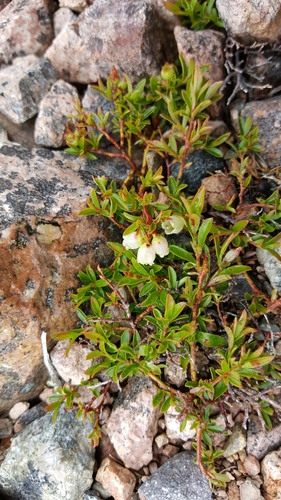
Northern Blueberry
Vaccinium boreale
A tiny titan of the tundra, the Northern Blueberry survives where few other plants dare to grow. This mat-forming shrub provides an essential summer feast for high-altitude wildlife and foragers alike.
Quick Identification
Size
Height: 5–10 cm (2–4 inches); Spread: Mat-forming up to 30 cm (12 inches)
Colors
Bright green leaves, white to pinkish-white flowers, and dusty blue berries with a waxy bloom
Key Features
- Extremely low-growing, mat-forming habit under 4 inches tall
- Narrow, lance-shaped leaves with tiny, finely serrated margins
- Small, bell-shaped flowers appearing in early summer
- Deep blue edible berries with a characteristic waxy 'bloom'
- Stems are dense and woody, often turning deep red in autumn
When You’ll See Them
Geographic range
Where Does the Northern Blueberry Live?
The Northern Blueberry is a specialist of the northeastern reaches of North America, where it thrives in the rugged, cold-hardy landscapes of the boreal forest and alpine zones. Its core range spans from the high peaks of the Adirondacks and New England’s White Mountains up through the Canadian provinces of Quebec, New Brunswick, and Newfoundland and Labrador. You will primarily find it on wind-swept rocky ridges and coastal headlands where the thin, acidic soil prevents larger, more aggressive plants from taking root.
Basemap © OpenStreetMap contributors
Behavior
Unlike its taller cousins, this species spreads slowly through an underground network of rhizomes, creating dense, resilient mats that hug the ground to avoid the desiccating effects of high-mountain winds. For humans, these plants offer a late-summer bounty of 'sweet hurts'—a local name referring to the intense sweetness of the fruit and the physical effort required to pick such tiny berries on rocky terrain. While they are not commonly 'tame' plants, they are highly respected by foragers and hikers for their resilience and concentrated flavor.
EverydayEarth exclusive
Camera Tips
Capturing the Northern Blueberry on a trail camera requires a specialized approach because of its diminutive size. To document the plant's life cycle or the wildlife it attracts, you must mount your camera just a few inches off the ground. Using a short tripod or a 'ground-pod' is highly recommended. Position the camera at a 45-degree angle looking down onto a healthy patch of the shrub to capture the transition from white bell-shaped blossoms to deep blue berries.
Because these berries are a high-energy food source, they act as a natural lure for wildlife. If you want to photograph the animals that eat them, place your camera near a fruiting patch in late July or August. You are likely to capture American Black Bears, Spruce Grouse, and a variety of small mammals like Red Squirrels and Voles. Since the action happens at ground level, ensure your camera has a fast trigger speed and a short minimum focal distance to avoid blurry images of visitors leaning in to graze.
Time-lapse mode is particularly effective for this species. Set your camera to take a photo every hour during the daylight over the course of a week in late June; this will allow you to see the flowers opening and being visited by pollinators. If you are using an AI-powered camera for identification, try to get a clear, close-up shot of the leaf margins and the stem—these fine details are the only way to distinguish the Northern Blueberry from the very similar Lowbush Blueberry.
Similar Species
Species that look similar or are commonly confused with Northern Blueberry.
Frequently Asked Questions
Record Northern Blueberry at your habitat
Connect a camera to start building your own species record — AI identifies every visitor automatically.