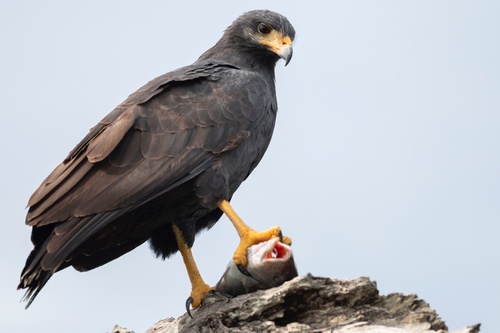
Common Black Hawk
Buteogallus anthracinus
A specialist hunter of the waterways, the Common Black Hawk is easily recognized by its sooty plumage and bold white tail band. Often seen perched low over streams, this raptor is a master at snatching crabs and fish from the water's edge.
Quick Identification
Size
Length 43–53 cm (17–21 in), wingspan 102–127 cm (40–50 in), weight 630–1,300 g (1.4–2.9 lbs)
Colors
Uniform sooty-black plumage with a single broad white band on a short tail; bright yellow legs, cere, and lores.
Key Features
- Single broad white median band on a short tail
- Vibrant yellow legs and base of beak (cere)
- Exceptionally broad, rounded wings
- Stocky, sooty-black body
- High-pitched piping whistle call
When You’ll See Them
Geographic range
Where Does the Common Black Hawk Live?
This striking raptor is native to the Americas, stretching from the riparian corridors of the Southwestern United States through Mexico and Central America into the northern reaches of South America. You will find their core populations thriving along the coastlines of the Caribbean and Pacific, as well as inland along major river systems in countries like Costa Rica, Panama, and Colombia. In the United States, they are a sought-after sight for birders in the desert canyons of Arizona and New Mexico during the summer breeding months.
Basemap © OpenStreetMap contributors
Behavior
The Common Black Hawk is a patient and methodical hunter, typically found perched quietly on a low branch overhanging a stream or marsh. Unlike more aerial hawks that soar for long periods, it spends much of its time stationary, watching the water for movement. When prey is spotted, it drops down with a powerful glide to snatch its meal from the water or the muddy bank with its talons. They are generally solitary or found in pairs during the breeding season, defending linear territories along river corridors.
While they are not typically 'backyard birds' in the suburban sense, they can become quite accustomed to human presence in parks or gardens that border significant waterways or mangroves. They are particularly vocal during the breeding season, emitting a series of high-pitched, piping whistles that often reveal their presence before they are seen. Their flight is heavy but direct, characterized by deep, rhythmic wingbeats that distinguish them from the more buoyant flight of vultures.
EverydayEarth exclusive
Camera Tips
To capture high-quality footage of a Common Black Hawk, your camera placement should be focused entirely on water features. These hawks are riparian specialists, so look for a 'hunting perch'—a sturdy, horizontal branch that hangs roughly 3 to 6 feet above a stream, pond, or mangrove channel. Position your camera on a nearby tree trunk at the same height as the perch, angled slightly downward to capture the hawk as it scans the water. If you are in a property that borders a creek, even a modest bird bath or a small, moving water feature can act as a lure.
Since these birds are diurnal and most active during the cooler morning hours, ensure your camera's trigger speed is set to its fastest setting. They often drop suddenly from their perch to grab prey, and a slow trigger will result in a frame of empty branches. Use 'Burst Mode' or high-definition video at 60 frames per second to capture the dramatic moment they splash into the water or grapple with a crab. Avoid placing cameras where the sun will reflect directly off the water surface into the lens, as the glare can ruin the exposure on the bird's dark plumage.
In terms of lures, Common Black Hawks are highly attracted to the movement of live aquatic prey. While we don't recommend manual feeding, maintaining a healthy, native-planted pond environment that naturally supports frogs and small fish is the best way to keep them coming back to your camera's field of view. During the spring, look for their large stick nests high in cottonwood or sycamore trees near water; positioning a long-range cellular camera with a view of the nest site can provide incredible insights into their family life without disturbing the birds.
Similar Species
Species that look similar or are commonly confused with Common Black Hawk.
Great Black Hawk
Slightly larger with longer legs; most importantly, the Great Black Hawk has two white tail bands compared to the Common's single band.
Zone-tailed Hawk
Has more slender wings and multiple narrow gray tail bands; it mimics Turkey Vultures in flight, whereas the Black Hawk has a heavy, direct flight.
Harris's Hawk
Has distinctive reddish-brown (rufous) patches on the shoulders and thighs, which the all-black Common Black Hawk lacks.
Frequently Asked Questions
Record Common Black Hawk at your habitat
Connect a camera to start building your own species record — AI identifies every visitor automatically.