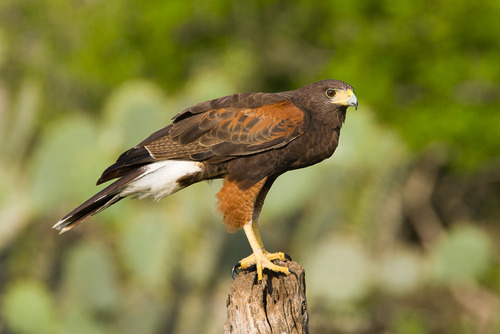
Harris's Hawk
Parabuteo unicinctus
The world's most social raptor, the Harris's Hawk, hunts in packs like a wolf and perches in stacks. Spot these chestnut-shouldered icons of the Southwest right in your backyard.
Quick Identification
Size
Length: 18–23 in (46–59 cm); Wingspan: 40–47 in (103–120 cm); Weight: 1.1–2.6 lbs (500–1,200 g)
Colors
Rich sooty brown body with prominent rufous (chestnut-red) patches on the shoulders and thighs. The tail is dark with a distinct white base and a white band at the tip.
Key Features
- Bright rufous shoulder patches and thighs
- Long dark tail with white base and white terminal band
- Yellow cere and long yellow legs
- Broad, rounded wings and relatively long legs for a hawk
When You’ll See Them
Geographic range
Where Does the Harris's Hawk Live?
Native to the Americas, the Harris's Hawk is a signature species of the arid Southwest. Its core range begins in the desert scrub of Arizona, New Mexico, and Texas, extending southward through the heart of Mexico and Central America. These hawks are also widely distributed across South America, thriving as far south as the semi-open plains of central Argentina and Chile. They are non-migratory residents, remaining in their social family territories throughout the year.
Basemap © OpenStreetMap contributors
Behavior
Unlike most raptors that are solitary and territorial, Harris's Hawks are remarkably social. Often called the 'wolves of the air,' they live and hunt in permanent family groups or 'casts' of up to seven individuals. This social structure includes a dominant breeding pair and several helpers who assist in hunting and raising the young. Their cooperative hunting strategy—where birds take turns flushing and pouncing on prey—is unique among birds of prey and allows them to take down much larger animals than a single hawk could handle.
In the backyard or desert landscape, you might witness 'stacking' behavior, where one hawk stands on the back of another. This isn't for mating, but rather a strategic move to gain a higher vantage point for spotting prey in areas with few tall trees. They are generally tolerant of human activity and have become popular in falconry due to their intelligence and social nature.
EverydayEarth exclusive
Camera Tips
To capture these 'wolves of the air,' you need to think about height and social interaction. Harris's Hawks love high vantage points. If you have a tall fence post, a dead tree (snag), or even a rooftop, mount your camera to face these perches. Because they often 'stack' on top of each other, angle your camera wide enough to catch a vertical group of two or three birds, rather than zooming in too tight on a single spot.
Water is a much more effective lure than food for backyard raptors. A large, sturdy birdbath or a low-profile water feature will attract them for both drinking and bathing, especially in the heat of the afternoon. Position your camera about 5-10 feet away from the water source at a slightly low angle (knee-height) to get dramatic, eye-level shots of them splashing or drying their wings.
Settings are crucial for fast-moving hawks. Use a high-speed burst mode or a video setting with a high frame rate (at least 60fps) to catch the incredible detail of their rufous feathers during takeoff. If your camera has a 'pre-trigger' or 'pro-capture' mode, enable it; Harris's Hawks are explosive when they launch from a perch, and this feature ensures you don't just get a tail-feather shot as they exit the frame.
Since they are social, if you see one, there are likely more nearby. Set your PIR (motion) sensor sensitivity to 'High' and keep the trigger interval short (less than 5 seconds). This allows the camera to reset quickly enough to capture the second and third members of the family group as they follow the leader to a perch or water source.
Similar Species
Species that look similar or are commonly confused with Harris's Hawk.
Red-tailed Hawk
Larger with a pale chest and a solid red tail; lacks the rufous shoulder patches and white tail base of the Harris's.
Swainson's Hawk
More slender with pointed wings and a distinct dark 'bib' on the chest; highly migratory compared to the resident Harris's.
Crested Caracara
Has a similar white tail base but features a distinctive orange face, black cap, and a much heavier, hooked beak.
Frequently Asked Questions
Record Harris's Hawk at your habitat
Connect a camera to start building your own species record — AI identifies every visitor automatically.