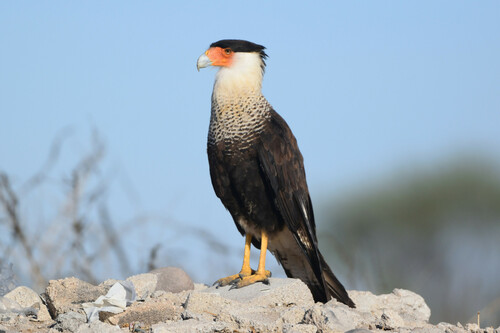
Crested Caracara
Caracara plancus
Part falcon, part vulture, and entirely unique, the Crested Caracara is the 'Mexican Eagle' of the Americas. Watch for this long-legged raptor strutting across open fields or surveying its kingdom from the top of a cactus.
Quick Identification
Size
Length: 50–65 cm (20–26 in); Wingspan: 120–132 cm (47–52 in); Weight: 800–1,300 g (1.8–2.9 lbs)
Colors
Dark brown or black body with white-and-black barred breast and neck; white wing tips and tail with a dark terminal band; orange-red facial skin
Key Features
- Distinctive black crest on a flat-topped head
- Bright orange-red or yellow naked facial skin
- Long, pale yellow legs built for walking
- White patches at the wing tips visible in flight
When You’ll See Them
Geographic range
Where Does the Crested Caracara Live?
The Crested Caracara is a true New World specialist, claiming a massive territory that stretches from the southern border of the United States all the way to the tip of South America in Tierra del Fuego. In North America, they are most commonly spotted in the ranchlands of Texas, the prairies of Florida, and the deserts of Arizona, though they are increasingly seen wandering further north into the Great Lakes and even Canada. While their core populations reside in Mexico, Central America, and the vast plains of Brazil and Argentina, they are highly adaptable and can be found in almost every mainland Latin American country.
Basemap © OpenStreetMap contributors
Behavior
The Crested Caracara is a unique member of the falcon family that behaves more like a vulture or a hawk. Unlike most falcons that hunt from the air, caracaras spend a significant amount of time on the ground, walking and even running with their long legs to hunt for insects or small vertebrates. They are highly social and intelligent birds, often seen in pairs or small family groups, and they are known to be quite bold, sometimes bullying other vultures away from a carcass.
These birds are exceptionally opportunistic foragers. While they are capable hunters of live prey, they are famous scavengers, frequently seen patrolling roadsides for roadkill or following tractors to catch insects and rodents disturbed by the plow. In areas with human activity, they are generally wary but adaptable, often using man-made structures like telephone poles as high-altitude vantage points to survey their territory.
EverydayEarth exclusive
Camera Tips
To capture the best footage of a Crested Caracara, position your camera much lower than you would for typical raptors. Since these birds spend a great deal of time walking and foraging on the ground, a camera mounted 2 to 3 feet off the ground, angled slightly upward, will capture their unique gait and long-legged silhouette. Look for "staging areas" like open patches of dirt near fence lines where they frequently land before surveying a field.
If you are looking to attract them specifically to your lens, caracaras are highly responsive to the sight of potential food. In rural or ranch settings, placing safe, legal bait like raw meat scraps or fresh roadkill in a wide-open area can bring them right in front of the sensor. Be sure your camera has a fast trigger speed, as they can be surprisingly quick when they decide to hop or run toward a food source. They are also attracted to water sources in arid environments, so a ground-level birdbath or trough is a great focal point.
Because they are most active during the cooler parts of the day, set your camera's sensitivity to high to catch the early morning and late afternoon light. Their white wing tips and breast can "blow out" (become overexposed) in harsh midday sun, so if possible, position the camera facing north or south to avoid direct glare. If you are in a region where they are year-round residents, winter is an excellent time for photography as the lack of dense foliage in scrublands makes their striking plumage pop against the brown landscape.
Similar Species
Species that look similar or are commonly confused with Crested Caracara.
Black Vulture
Black Vultures lack the Caracara's long yellow legs and white tail, and have a grey, featherless head instead of orange facial skin.
Northern Harrier
Harriers have a distinctive white rump patch and a more owl-like facial disk, lacking the Caracara's heavy bill and crest.
Turkey Vulture
Turkey Vultures have a red head and fly in a pronounced 'V' shape, whereas Caracaras have a more direct flight path with flat wings.
Frequently Asked Questions
Record Crested Caracara at your habitat
Connect a camera to start building your own species record — AI identifies every visitor automatically.