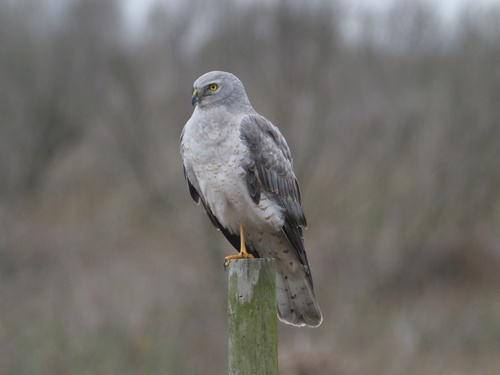
Northern Harrier
Circus hudsonius
The 'Grey Ghost' of the grasslands, the Northern Harrier is a master of low-altitude acrobatics. With its distinctive owl-like face and striking white rump, this hawk is a captivating sight for any backyard observer with a view of the open fields.
Quick Identification
Size
Length: 41-50 cm (16-20 in); Wingspan: 97-122 cm (38-48 in); Weight: 300-600g (10.6-21.2 oz)
Colors
Males are distinctive 'Grey Ghosts' with pale grey backs and white bellies; females and juveniles are streaked brown. All have a brilliant white rump patch.
Key Features
- Bright white patch on the upper rump
- Owl-like facial disk for acoustic hunting
- Long, narrow wings held in a 'V' or dihedral shape
- Slender tail with dark banding
When You’ll See Them
Behavior
The Northern Harrier is a unique raptor known for its 'buoyant' flight style. Unlike many hawks that soar at high altitudes, the Harrier hugs the ground, gliding just a few feet above tall grasses and marshes. It uses a combination of sharp vision and an owl-like facial disk to locate prey by sound, allowing it to strike rodents hidden deep within the brush.
These birds are highly territorial during the breeding season and are famous for their elaborate 'sky-dancing' courtship displays, where males perform dizzying loops and rolls to impress females. They are one of the few raptor species in North America that nests on the ground, usually hidden within dense vegetation or reeds to protect their young from land-based predators.
EverydayEarth exclusive
Camera Tips
To capture the Northern Harrier on camera, you must think low. Because these birds hunt by skimming just above the vegetation, a camera mounted high in a tree will likely miss them or only capture the tops of their wings. Instead, mount your camera on a fence post or a sturdy garden stake about 3 to 4 feet off the ground, angled slightly upward to capture the bird as it glides past. If you have a large meadow or an open field, placing the camera at the edge where the grass meets a clearing is your best bet.
Since Harriers are sensitive to movement and noise, a camera with a 'No-Glow' or 'Black Flash' infrared system is essential for capturing natural behavior without startling them. Set your camera to 'Burst Mode' or high-speed video. Harriers move quickly and erratically when they detect prey, so a single still photo often results in a blurred wing or a missed tail. A 3-5 second video clip or a 3-photo burst increases your chances of getting that iconic shot of their white rump patch or facial disk.
Timing is everything with this species. They are most active during the 'golden hours' of early morning and late afternoon when rodents are moving but there is still enough light for the Harrier to hunt. In the winter, look for them over snow-covered fields where their dark brown or grey feathers provide a striking contrast. You don't need bait for these birds—they are attracted to high concentrations of voles. If you have a 'wild' corner of your property with tall, uncut grass, that is where the Harrier will spend most of its time patrolling.
Similar Species
Species that look similar or are commonly confused with Northern Harrier.
Cooper's Hawk
Smaller with shorter, rounded wings and lacks the white rump patch; typically found in wooded areas rather than open marshes.
Rough-legged Hawk
A winter visitor that also hunts in open fields but is much bulkier and lacks the distinctive owl-like face disk.
Short-eared Owl
Often hunts the same fields at dusk; has a similar facial disk but blunter wings and a different, more moth-like flight pattern.
Frequently Asked Questions
Record Northern Harrier at your habitat
Connect a camera to start building your own species record — AI identifies every visitor automatically.