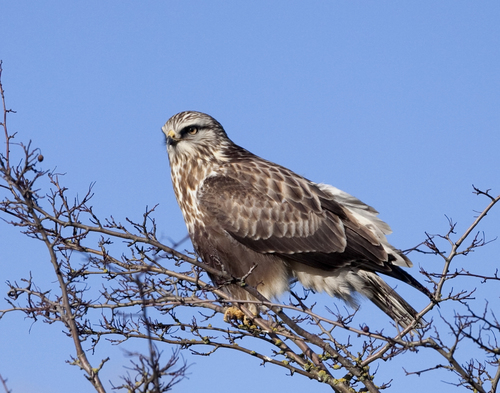
Rough-legged Hawk
Buteo lagopus
A majestic visitor from the Arctic tundra, the Rough-legged Hawk is a master of the winter winds. Known for its unique feathered legs and its ability to hover like a kestrel, it brings a touch of the wild north to open fields and prairies.
Quick Identification
Size
Length: 18-24 in (46-60 cm); Wingspan: 47-60 in (120-153 cm); Weight: 1.6-3.1 lbs (715-1,400 g)
Colors
Highly variable plumage; light morphs feature a pale head, dark belly band, and dark wrist patches. Dark morphs are chocolate brown to black. Both have a white tail base with a dark terminal band.
Key Features
- Feathered legs down to the base of the toes
- Distinctive dark 'carpal patches' on the underside of the wings
- Broad, dark belly band on light-colored individuals
- Frequent hovering or 'kiting' behavior while hunting
When You’ll See Them
Behavior
The Rough-legged Hawk is a specialist of the open country, spending its summers in the treeless Arctic tundra and migrating to the temperate fields and marshes of the south for the winter. These hawks are remarkably hardy and are often seen perched on the smallest twigs or thin fence posts that other large raptors might avoid. One of their most fascinating behaviors is 'kiting'—hovering in place against the wind while keeping their head perfectly still to scan for movement in the grass below.
Unlike many other Buteos that are quite wary of human presence, the Rough-legged Hawk can be surprisingly approachable. This is likely because they spend their breeding season in remote northern regions where they rarely encounter people. In the winter, they are mostly solitary, though you might see several in a single large field if the rodent population is booming. They are silent hunters during the winter, saving their vocalizations for the rocky cliffs of their northern nesting grounds.
EverydayEarth exclusive
Camera Tips
To capture a Rough-legged Hawk on your trail camera, you need to think like a hunter in an open landscape. Because these birds don't visit traditional bird feeders, your camera placement should focus on 'perch potential.' If your property has a lone fence post or a dead snag in the middle of a field, that is your primary target. If no natural perches exist, you can 'plant' a 10-foot 4x4 post with a cross-arm in an open area. Mount your camera on a secondary post about 8 to 12 feet away, aimed at the top of the perch. This distance is crucial; these hawks have massive wingspans, and being too close will result in nothing but a blur of feathers during takeoff.
Lighting is your best friend and worst enemy with this species. Because they come in both light and dark morphs, harsh midday sun can wash out the identifying features of a light-colored hawk or turn a dark morph into a featureless silhouette. Position your camera facing north to ensure the bird is front-lit by the southern sun throughout the day. Set your AI camera to its highest trigger speed and use 'burst mode' if available. The most dramatic shots often occur in the split second they lift their wings to balance or begin a dive.
Since Rough-legged Hawks are winter visitors, battery management is key. Cold temperatures can sap standard alkaline batteries in days. Use lithium batteries to ensure your camera stays active during the freezing morning hours when these hawks are most active. If you are using an AI-powered camera, ensure the sensitivity is set to high; the 'kiting' or hovering behavior often happens 15-20 feet above the ground, and a sensitive sensor can catch the bird as it descends toward a perch even before it lands.
Similar Species
Species that look similar or are commonly confused with Rough-legged Hawk.
Red-tailed Hawk
Lacks feathered legs and has a signature cinnamon-red tail as an adult, with different underwing markings.
Ferruginous Hawk
Larger with a much wider gape (mouth) and typically lacks the dark wrist patches of the Rough-legged.
Northern Harrier
Much slimmer with a long tail and a white rump patch, usually flying very low over the ground in a 'V' shape.
Frequently Asked Questions
Record Rough-legged Hawk at your habitat
Connect a camera to start building your own species record — AI identifies every visitor automatically.