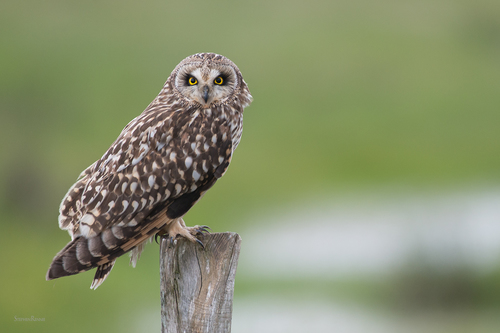
Short-eared Owl
Asio flammeus
A master of the meadows, the Short-eared Owl is one of the few owls you can spot hunting under the glow of a setting sun. With its piercing yellow eyes and silent, moth-like flight, it is a spectacular visitor to open backyard landscapes.
Quick Identification
Size
Length: 34-43 cm (13-17 in); Wingspan: 85-110 cm (33-43 in); Weight: 200-475 g (7-17 oz)
Colors
Mottled tawny-brown upperparts with heavy streaking; pale, buffy-white underparts with vertical brown streaks; facial disc is whitish with prominent black rings around yellow eyes.
Key Features
- Small, often invisible ear tufts located near the center of the forehead
- Bright yellow eyes framed by dark black 'mascara' rings
- Distinctive 'wrist' patches (dark carpal patches) visible on the underside of the wings
- Buoyant, erratic, moth-like flight pattern over open ground
When You’ll See Them
Behavior
The Short-eared Owl is a charismatic outlier in the owl world, frequently observed hunting during daylight hours, particularly at dawn and dusk. Unlike many of its strictly nocturnal cousins, this species favors wide-open spaces like grasslands, marshes, and agricultural fields. Their flight is remarkably distinctive; they glide and flap with a rhythmic, rowing motion that looks almost like a giant moth fluttering over the tall grass.
Socially, these owls are fascinating. While many raptors are fiercely territorial, Short-eared Owls can be quite gregarious during the winter months. They are known to form communal roosts, sometimes with dozens of individuals huddling together in thickets or on the ground to conserve heat. When it comes to humans, they are generally wary but can be bold when defending their nests, which are uniquely situated directly on the ground amidst dense vegetation.
EverydayEarth exclusive
Camera Tips
To capture high-quality footage of a Short-eared Owl, you must understand their perching habits. These owls love to survey their hunting grounds from low-profile vantage points. If your property borders a field or marsh, look for existing fence posts or 'T-posts.' If none exist, you can 'manufacture' a perfect shot by driving a 5-foot wooden stake into the ground about 15-20 feet away from a brush line. Mount your camera on a secondary post facing this perch. Because they hunt at dusk, ensure your camera has a high-quality CMOS sensor for superior low-light performance without relying solely on grain-heavy infrared.
Placement height is critical. Unlike forest owls that prefer high canopies, Short-eared Owls are most comfortable between 3 and 6 feet off the ground. Angle your camera slightly upward if the sun is setting behind it to catch the golden hour light hitting their pale facial discs. Avoid using heavy baits; instead, focus on habitat management. Keeping a patch of tall, unmown grass will naturally attract the voles and mice that serve as a 'live lure' for these raptors, making your camera site a recurring stop on their nightly patrol.
For settings, prioritize a fast trigger speed (0.2s or less) and a high frame rate. Because their flight is erratic and 'floppy,' a slow camera will often result in a blur of wings rather than a clear image. If your camera supports a 'Hybrid Mode,' set it to take a high-resolution photo followed by a 15-second video. This allows you to identify individual markings on the chest while also capturing their unique rowing flight motion. During the winter, check your cameras near ground-level thickets or evergreen clusters, as these are likely spots for communal roosting.
Similar Species
Species that look similar or are commonly confused with Short-eared Owl.
Frequently Asked Questions
Record Short-eared Owl at your habitat
Connect a camera to start building your own species record — AI identifies every visitor automatically.