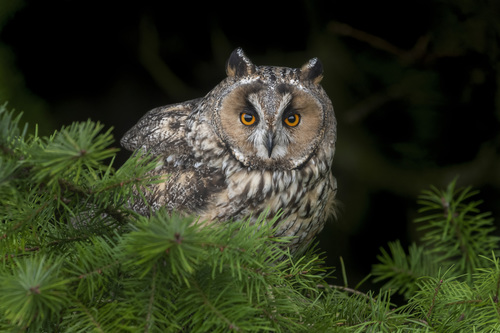
Long-eared Owl
Asio otus
With its striking orange eyes and dramatic feather 'ears,' the Long-eared Owl is the phantom of the forest edge. Masterfully camouflaged and deeply secretive, this nocturnal hunter is a prize find for any backyard wildlife enthusiast.
Quick Identification
Size
Length: 35-40 cm (14-16 in); Wingspan: 90-100 cm (35-39 in); Weight: 220-435 g (7.8-15.3 oz)
Colors
Mottled brown and gray upperparts with buff-orange facial discs. Buff-colored underparts with dark vertical streaks and horizontal barring. Intense orange or yellow eyes.
Key Features
- Long, prominent vertical ear tufts set close together
- Bright orange-buff facial discs with white 'X' between eyes
- Deep vertical streaking on chest and belly
- Slender body compared to other large owls
When You’ll See Them
Geographic range
Where Does the Long-eared Owl Live?
The Long-eared Owl claims a massive native territory spanning the temperate regions of North America, Europe, and Asia. In the Western Hemisphere, their core range extends from southern Canada across the majority of the United States, while across the Atlantic, they are found from the British Isles and Scandinavia through Russia and into northern China and Japan. While many populations remain resident year-round, northernmost breeders are known to migrate south during harsh winters to find more accessible prey.
Basemap © OpenStreetMap contributors
Behavior
The Long-eared Owl is a master of camouflage and one of the most secretive raptors in the Northern Hemisphere. During the day, they sit motionless in dense foliage, stretching their bodies and narrowing their eyes to mimic a broken tree branch. Unlike many other solitary owls, they are remarkably social during the winter, often forming communal roosts in thick evergreen stands where dozens of individuals may huddle together for warmth and safety.
While they are strictly nocturnal hunters, their presence is often revealed by their low, hooting calls during the breeding season. They are generally shy around humans and will stay perfectly still until an intruder is nearly upon them. If a human approaches too closely to a nest, adults may perform a 'distraction display,' feigning injury to lure the threat away—a behavior more common in ground-nesting birds than forest owls.
EverydayEarth exclusive
Camera Tips
Capturing a Long-eared Owl on camera requires a strategic focus on 'edge' habitats. These owls spend their days in dense cover but hunt in open spaces. Position your camera at the transition zone where a thicket of evergreens or dense brush meets an open field. Aim the lens toward a prominent, low-hanging branch—roughly 5 to 8 feet off the ground—that offers a clear view of the clearing. This is where they often perch to scan for movement before diving for a vole.
Since these owls are strictly nocturnal, a camera with high-quality infrared (IR) or 'no-glow' flash is essential. Standard white flashes will spook them and likely prevent them from returning to that spot. Set your camera to 'Burst Mode' or 'Photo + Video' to increase your chances of catching the owl's distinctive silhouette in motion. Because they are light on their feet and silent in flight, set your PIR (Passive Infrared) sensor to its highest sensitivity to ensure the shutter is triggered by their body heat as they land or take off.
While we don't recommend using live bait, you can attract their attention by enhancing the habitat for their natural prey. A small brush pile or a patch of unmowed tall grass near your camera site will naturally attract mice and voles, which in turn brings the owls. If you are tracking a known winter roost, place your camera on a nearby tree facing the roosting grove from at least 20 feet away to avoid disturbing them; they are highly sensitive to human presence and may abandon a site if they feel watched.
Winter is the best time for high-volume captures because of their communal roosting habits. Look for 'whitewash' (droppings) and pellets at the base of dense conifers to find their favorite perches. During the spring, move your setup toward more open hunting grounds or the margins of wetlands. Always ensure the camera is mounted securely, as winter winds in open fields can cause false triggers or blurry images if the mount is unstable.
Similar Species
Species that look similar or are commonly confused with Long-eared Owl.
Frequently Asked Questions
Record Long-eared Owl at your habitat
Connect a camera to start building your own species record — AI identifies every visitor automatically.