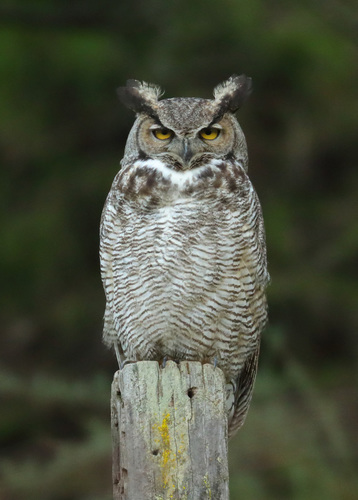
Great Horned Owl
Bubo virginianus
The ultimate nocturnal apex predator, the Great Horned Owl is famous for its iconic 'hoo-h'hoo-hoo-hoo' call and striking yellow eyes. This adaptable hunter is likely the most powerful bird of prey in your neighborhood.
Quick Identification
Size
Length: 43–64 cm (17–25 in); Wingspan: 91–153 cm (36–60 in); Weight: 0.6–2.5 kg (1.4–5.5 lbs)
Colors
Mottled grayish-brown with reddish-brown tones; white throat patch; horizontal barring on the underparts; yellow eyes.
Key Features
- Prominent 'ear' tufts or plumicorns
- Large, bright yellow eyes
- White patch on the throat (the 'bib')
- Broad, rounded wings and a short tail
When You’ll See Them
Sightings on EverydayEarth
Jun 29, 2026
A Great Horned Owl is perched on a post at the edge of the nest, preening its feathers. Meanwhile, an adult Osprey is hunkered down in the nest bowl, likely brooding eggs or young chicks during a rain shower.
Jun 29, 2026
A Great Horned Owl is perched on a post overlooking the Osprey nest during the night. The owl is active and alert, rotating its head to scan the surroundings. In the foreground, an Osprey remains hunkered down and stationary within the nest, likely protecting its territory or young from the nearby predator.
Jun 29, 2026
Under the cover of night, an Osprey rests in its nest. In the background, a Great Horned Owl is perched motionless on a wooden post, observing the nest and the surrounding area. Several blurry orbs of reflected light are scattered across the frame, likely caused by moisture or dust on the camera lens.
Jun 29, 2026
A Great Horned Owl is perched on a wooden post overlooking a large raptor nest at night. In the foreground, another large bird remains hunkered down and mostly stationary within the nest structure. During the sequence, a piece of debris or a stick falls vertically in the background on the left side of the frame.
Jun 28, 2026
A juvenile Osprey rests in the nest at night, looking around alertly. In the background, a Great Horned Owl is perched on a tall wooden post, watching the nest area. The Osprey chick turns its head frequently, monitoring its surroundings in the infrared light.
Jun 28, 2026
Under the cover of darkness, an Osprey is hunkered down in its nest. A Great Horned Owl is perched menacingly on a wooden post overlooking the nest, looking downward. Neither bird moves significantly during the sequence, creating a tense nocturnal scene.
Geographic range
Where Does the Great Horned Owl Live?
The Great Horned Owl is native across the North American continent, stretching from the northern tree line in Alaska and Canada down through the entire United States and Mexico. Its range continues through Central America and across much of South America, making it one of the most widely distributed raptors in the Western Hemisphere. While they are found in nearly every climate zone, they are most common in areas where open hunting grounds meet dense stands of trees for nesting.
Basemap © OpenStreetMap contributors
Behavior
The Great Horned Owl is a fierce and powerful predator, often nicknamed the 'Tiger of the Air' for its ability to take down prey significantly larger than itself. They are primarily nocturnal, beginning their activity at dusk, though they may occasionally hunt during the day in winter. These owls are highly territorial and tend to stay in the same home range year-round, using their deep, rhythmic hooting to advertise their presence to rivals and mates.
While they are solitary for most of the year, they form monogamous pairs during the breeding season. Interestingly, they do not build their own nests, instead hijacking the abandoned stick nests of hawks, crows, or squirrels, or nesting in tree hollows and cliff ledges. In suburban environments, they are remarkably tolerant of human activity, often perching on rooftops or telephone poles to scan for backyard rodents.
EverydayEarth exclusive
Camera Tips
To capture a Great Horned Owl on your backyard camera, focus on high-vantage points rather than ground-level activity. These owls love to perch on 'lookout' spots such as fence posts, the peaks of sheds, or sturdy horizontal branches at the edge of a clearing. Mounting your camera 6 to 10 feet high and angling it slightly downward toward a known perch is the most effective strategy. If you have a bird bath, you might even catch them taking a rare nocturnal dip or a drink.
Because Great Horned Owls are active in near-total darkness, high-quality infrared (IR) night vision is essential. Look for a camera with a fast trigger speed (0.3 seconds or less) because their flight is nearly silent and very swift; a slow camera will only catch a blur of feathers or a trailing wing. Since they are attracted to the sound and movement of small mammals, placing your camera near areas where you already see rabbits or mice—such as brush piles or under bird feeders—will naturally increase your chances of a sighting.
During the late fall and winter (November through February), Great Horned Owls become much more vocal and active as they establish territories and court mates. This is the prime time to set your camera to video mode. Use 'all-motion' sensitivity settings at night, as AI-models trained for humans or pets might sometimes overlook the silhouette of a perched bird. If your camera has an adjustable PIR (Passive Infrared) sensor, set it to high sensitivity during the winter months to ensure you don't miss these 'ghosts of the woods' as they glide past.
Similar Species
Species that look similar or are commonly confused with Great Horned Owl.
Frequently Asked Questions
Record Great Horned Owl at your habitat
Connect a camera to start building your own species record — AI identifies every visitor automatically.