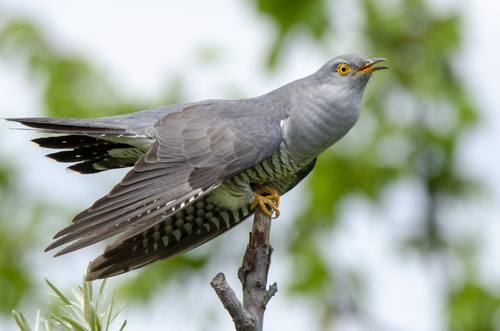
Common Cuckoo
Cuculus canorus
The Common Cuckoo is the ultimate trickster of the bird world, famous for its iconic 'cu-coo' call and its daring brood-parasite lifestyle. These long-distance migrants travel thousands of miles each year, bringing the sound of spring to gardens and wild spaces across the globe.
Quick Identification
Size
32–36 cm (12.6–14.2 in) long, 54–60 cm (21.3–23.6 in) wingspan, 110–130 g (3.9–4.6 oz)
Colors
Lead-grey upperparts and throat; white underparts with dark horizontal barring. Females occasionally occur in a 'hepatic' (rufous-brown) morph with heavy barring.
Key Features
- Pointed wings and long, graduated tail
- Slate-grey plumage with hawk-like chest barring
- Yellow ring around the eye and yellow feet
- Distinctive 'cu-coo' vocalization in males
When You’ll See Them
Geographic range
Where Does the Common Cuckoo Live?
The Common Cuckoo is a master of migration, hailing from the Palearctic region spanning across Europe and Northern Asia. During the breeding months, they can be found from the British Isles and Scandinavia all the way across Russia to China and Japan, as well as parts of North Africa. As winter approaches, these birds undertake an epic journey to the tropical regions of Sub-Saharan Africa and Southeast Asia to escape the cold.
Basemap © OpenStreetMap contributors
Behavior
The Common Cuckoo is a solitary and elusive bird, world-renowned for its strategy of brood parasitism. Instead of building their own nests, females sneak their eggs into the nests of other bird species, such as Reed Warblers or Dunnocks. They have evolved to be masters of deception, with the female's plumage often mimicking a Sparrowhawk to scare host birds away from their nests, allowing her a window to deposit her egg in a matter of seconds.
Once hatched, the Cuckoo chick instinctively ejects the host's own eggs or young from the nest to ensure it receives all the food brought by the foster parents. Outside of the breeding season, they are quiet and secretive, spending most of their time high in the canopy or perched on utility wires, scanning the ground for movement. While they are often heard, their shy nature makes them a challenge to spot without the help of a motion-activated camera.
EverydayEarth exclusive
Camera Tips
Capturing a Common Cuckoo on camera requires a bit more strategy than your average garden bird. Because they are arboreal and somewhat shy, avoid placing cameras at ground level. Instead, mount your camera 2 to 3 metres high on a tree trunk overlooking an open clearing or a known flight path. If you have a pond with reed beds or a meadow where Meadow Pipits or Reed Warblers nest, aim your camera toward these areas, as female Cuckoos will be lurking there to scout for potential host nests.
While you can't easily bait a Cuckoo with seeds or suet, you can use their territorial nature to your advantage. During the spring (April and May), using an audio lure that plays the male’s 'cu-coo' call can bring them within range of your camera. However, do this sparingly to avoid distressing the birds and check local wildlife regulations. Position the camera with a wide-angle view to capture their hawk-like flight pattern, as they often approach perches with a direct, low-gliding motion.
For the best results, use a high-speed trigger and a fast shutter speed. Cuckoos are surprisingly quick when they decide to move. Set your camera to burst mode (3-5 photos per trigger) or high-definition video. The best time for activity is early morning when the males are most vocal and active in defending their territory. Use a high-quality SD card to ensure you don't miss the fast action of a female Cuckoo visiting a host nest, which often takes less than ten seconds.
Seasonality is everything for this species. In Europe and the UK, your window of opportunity is narrow, usually from late April to early July. Once the eggs are laid and the caterpillars begin to dwindle, the adults start their southward migration, often leaving as early as July, while the juveniles follow later in August. Ensure your PIR sensors are set to high sensitivity, as their grey plumage can sometimes blend into the leafy background on overcast days.
Similar Species
Species that look similar or are commonly confused with Common Cuckoo.
Eurasian Sparrowhawk
The hawk has broad, rounded wings and a hooked beak, whereas the Cuckoo has pointed, falcon-like wings and a straight bill.
Oriental Cuckoo
Nearly identical visually; distinguished by its deeper, four-note 'bo-bo-bo-bo' call compared to the classic two-note call of the Common Cuckoo.
Frequently Asked Questions
Record Common Cuckoo at your habitat
Connect a camera to start building your own species record — AI identifies every visitor automatically.