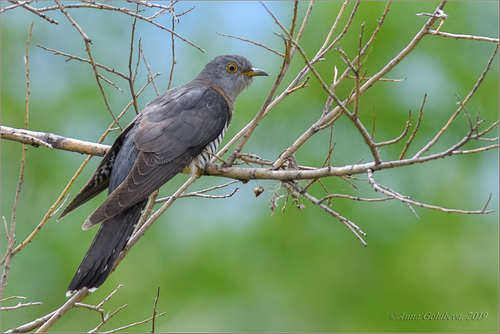
Oriental Cuckoo
Cuculus optatus
A phantom of the forest canopy, the Oriental Cuckoo is famous for its haunting double-note call and its clever, parasitic nesting habits. This long-distance traveler links the Siberian wilderness to the tropical forests of Australia.
Quick Identification
Size
Length: 30-34 cm (12-13.4 in); Wingspan: 50-60 cm (19.7-23.6 in); Weight: 73-115 g (2.6-4.1 oz)
Colors
Slate-grey upperparts and throat; white underparts with broad, dark horizontal bars; yellow eye-ring; females occasionally occur in a rufous 'hepatic' morph with reddish-brown barring.
Key Features
- Distinctive two-note 'hoo-hoo' call
- Broad, dark horizontal bars on a white belly
- Bright yellow eye-ring and yellow feet
- Long, pointed wings and a graduated tail in flight
When You’ll See Them
Geographic range
Where Does the Oriental Cuckoo Live?
This wide-ranging traveler is native to the vast forest belts of Northern Eurasia, stretching from the Russian taiga and Siberia eastward to Japan and Northern China. During the winter months, the Oriental Cuckoo embarks on a long-distance migration to warmer climates, covering a massive territory that includes Southeast Asia, Indonesia, and as far south as Northern and Eastern Australia. While they are forest specialists, they can frequently be spotted in coastal scrubs and suburban greenery while they are on the move between their breeding and wintering grounds.
Basemap © OpenStreetMap contributors
Behavior
The Oriental Cuckoo is a master of stealth and deception. Primarily known as a brood parasite, it does not build its own nest or raise its own young. Instead, females carefully monitor the nests of smaller songbirds, such as leaf warblers, wait for the opportune moment, and quickly swap one of the host's eggs for her own. The cuckoo chick typically hatches first and instinctively ejects the other eggs or nestlings, ensuring it receives the undivided attention and food from its foster parents.
In the wild, these birds are quite shy and spend much of their time perched motionless in the mid-to-upper canopy of the forest, watching for prey. They are solitary birds, rarely seen in groups except during migration. While they are difficult to spot visually because their plumage blends perfectly with the shadows and branches, their deep, rhythmic calls are a hallmark of the northern forests in spring and summer.
EverydayEarth exclusive
Camera Tips
To capture an Oriental Cuckoo on camera, height is your best friend. These birds are arboreal and rarely descend to the ground unless attracted by a specific food source. If you have an AI-powered camera like those from EverydayEarth, try mounting it 10 to 15 feet high on a sturdy tree trunk, angled slightly downward toward a horizontal 'staging branch' where a bird might land before heading into a thicker canopy.
Because they are attracted to caterpillars, planting native trees that host larvae—like oaks, birches, or pines—is the most effective way to lure them into your camera's field of view. Avoid using chemical pesticides in your yard, as the Oriental Cuckoo is specifically looking for the large, hairy caterpillars that many gardeners try to eliminate. A garden rich in insect life is their primary draw.
Set your camera to high-sensitivity motion detection, as their movements can be slow and deliberate while hunting. Early morning is the best time for clear shots, as this is when they are most active and vocal. If your camera supports audio-triggered recording, the distinctive 'hoo-hoo' call is a perfect trigger for capturing video clips of this elusive species during the breeding season.
Similar Species
Species that look similar or are commonly confused with Oriental Cuckoo.
Common Cuckoo
The Common Cuckoo has a thinner-barred belly and a famous two-syllable 'cuck-oo' call with a higher pitch.
Himalayan Cuckoo
Nearly identical in appearance; the Himalayan Cuckoo's call is usually lower in pitch and has a different rhythmic structure (usually 3-4 notes).
Japanese Sparrowhawk
In flight, the cuckoo mimics this hawk's appearance to scare host birds, but it lacks the hawk's hooked beak and powerful talons.
Frequently Asked Questions
Record Oriental Cuckoo at your habitat
Connect a camera to start building your own species record — AI identifies every visitor automatically.