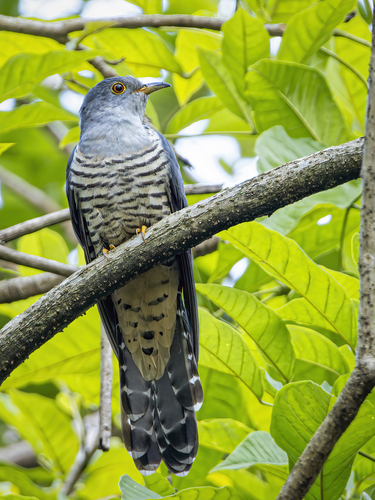
Himalayan Cuckoo
Cuculus saturatus
The Himalayan Cuckoo is a ghost of the high-altitude forests, known for its rhythmic four-note song and its fascinatingly deceptive lifestyle as a brood parasite.
Quick Identification
Size
Length: 30–32 cm (11.8–12.6 in); Wingspan: 51–57 cm (20–22.5 in); Weight: 75–100 g (2.6–3.5 oz)
Colors
Blue-grey head and upperparts, white underparts with thick dark-grey horizontal bars, yellow iris and eye-ring
Key Features
- Distinctive rhythmic four-note call 'hoop-hoop-hoop-hoop'
- Broad, widely spaced dark bars on the belly
- Hawk-like profile in flight with pointed wings
- Bright yellow eye-ring and iris
When You’ll See Them
Geographic range
Where Does the Himalayan Cuckoo Live?
Native to the Asian continent, the Himalayan Cuckoo thrives in the high-altitude landscapes stretching from the Himalayas through northern India, Nepal, and Bhutan. Its breeding range extends eastward into southern China and Taiwan, favoring temperate mountain forests. During the winter months, the species migrates south to the tropical climates of Southeast Asia and the Greater Sunda Islands, including Indonesia and Malaysia, to avoid the harsh mountain winters.
Basemap © OpenStreetMap contributors
Behavior
The Himalayan Cuckoo is a master of stealth and sound, often heard long before it is seen. It spends most of its life hidden within the dense canopies of mountain forests, where it moves with a swift, predatory flight pattern that mimics a hawk. This mimicry is a clever survival tactic, scaring smaller birds away from their nests so the cuckoo can identify potential hosts for its eggs.
As a brood parasite, this species does not build its own nest or raise its own young. Instead, females carefully monitor the nests of small passerines, particularly leaf warblers. When the host bird leaves the nest momentarily, the cuckoo quickly replaces one egg with its own. The cuckoo chick typically hatches earlier and grows faster than its nestmates, often ejecting the host's biological eggs or chicks to ensure it receives all the food brought by the unwitting foster parents.
EverydayEarth exclusive
Camera Tips
Capturing a Himalayan Cuckoo on camera requires a strategic approach because they rarely visit the ground. For the best results, mount your AI camera high in the trees, ideally 10 to 15 feet up, overlooking a canopy clearing or a prominent horizontal branch that might serve as a singing perch. Because they are attracted to the nests of host species, placing a camera near known Leaf Warbler nesting sites can provide a rare glimpse of a female scouting for a host.
Since these birds do not visit traditional seed or suet feeders, you cannot lure them with standard bird food. Instead, focus on creating an insect-friendly environment. A yard with mature, native trees that support a healthy population of caterpillars is your best bet. If you have a water feature like a high-placed birdbath or a misting system in a wooded area, you might catch them coming down for a quick drink or bath during the heat of the afternoon.
Set your camera to take short video bursts (15-20 seconds) rather than just stills. The Himalayan Cuckoo has a unique 'pumping' motion when it calls, which is much more interesting to see in motion. Ensure your trigger speed is set to the fastest possible setting, as their flight is incredibly rapid and hawk-like. Because they are most vocal and active in the early morning, make sure your camera is positioned to avoid direct sunrise glare, which can wash out the subtle grey markings that distinguish them from other cuckoo species.
Similar Species
Species that look similar or are commonly confused with Himalayan Cuckoo.
Common Cuckoo
Features finer, more closely spaced belly bars and a distinct two-note call.
Oriental Cuckoo
Visually nearly identical but has a different vocal resonance and a range that extends further north into Siberia.
Indian Cuckoo
Has a four-note call with a different cadence (often described as 'one-more-bottle') and lacks the prominent yellow eye-ring.
Frequently Asked Questions
Record Himalayan Cuckoo at your habitat
Connect a camera to start building your own species record — AI identifies every visitor automatically.