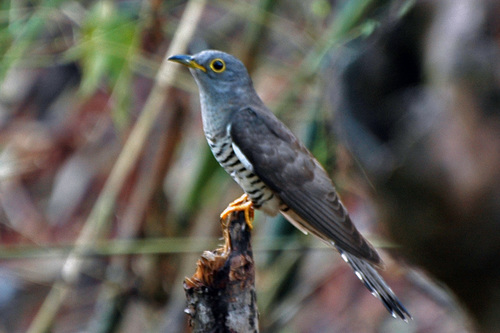
Indian Cuckoo
Cuculus micropterus
Often heard but rarely seen, the Indian Cuckoo is the phantom of the forest canopy. Famous for its 'one-more-bottle' whistle and its clever brood-parasitic lifestyle, this bird is a prize for any backyard observer.
Quick Identification
Size
Length 31–33 cm (12–13 in); Weight 80–120 g (2.8–4.2 oz); Wingspan 50–60 cm (20–24 in)
Colors
Grey-brown upperparts and wings, white underparts with broad dark-grey horizontal bars, grey head, and a distinctive yellow orbital ring around the eye.
Key Features
- Distinctive four-note 'one-more-bottle' call
- Broadly barred white belly and under-tail
- Prominent yellow eye-ring
- Grey head and breast contrasting with brown-tinted wings
When You’ll See Them
Geographic range
Where Does the Indian Cuckoo Live?
Native to the vast landscapes of Asia, the Indian Cuckoo spans a massive range from the Indian subcontinent across to Southeast Asia and north into China and Russia. It is commonly found throughout India, Bangladesh, Bhutan, Nepal, and Sri Lanka, extending its presence into Indonesia and the Philippines. In the northern parts of its range, it is a summer visitor, while populations in tropical regions may be resident or local migrants.
Basemap © OpenStreetMap contributors
Behavior
The Indian Cuckoo is a master of stealth and sound, often heard long before it is seen. It is a solitary bird, spending much of its time high in the forest canopy. During the breeding season, males become highly vocal, repeating their famous four-note whistle throughout the day and even into the night to establish territory and attract mates. This persistent calling is one of the hallmark sounds of the Asian summer.
As a brood parasite, the Indian Cuckoo does not build its own nest. Instead, it carefully monitors the nests of other birds—frequently Drongos, Shrikes, and Crows—to sneak in and lay a single egg. This strategy ensures their young are raised by foster parents, often at the expense of the host's own chicks. Despite this ruthless reputation in the avian world, they are shy and rarely interact with humans directly, preferring the safety of dense foliage.
EverydayEarth exclusive
Camera Tips
Capturing the Indian Cuckoo on a backyard or trail camera requires a strategy focused on elevation and canopy edges. Because these birds are predominantly arboreal and rarely descend to the ground, placing your camera at a height of at least 10 to 15 feet—ideally on a balcony or a sturdy branch overlooking a clearing—is much more effective than ground-level setups. Angle the camera slightly upward to capture the mid-to-high canopy where they forage for caterpillars.
Since they are brood parasites, look for 'hotspots' where their host species, such as Black Drongos or Long-tailed Shrikes, are nesting. The female cuckoo will often perch motionless on a nearby branch for long periods, scouting the host nest for the perfect moment to strike. Positioning your camera near these potential host nests increases your chances of capturing this rare behavior. During the peak breeding season (April to June), focus your efforts on areas where you hear their 'one-more-bottle' call consistently.
To attract them closer to a camera lens, prioritize habitat over traditional birdseed bait, which they won't eat. Planting native trees that attract large caterpillars or maintaining a 'wild' corner of your garden can serve as a natural lure. For camera settings, use a fast shutter speed (1/1000s if possible) or a high-frame-rate video mode to capture their swift, hawk-like flight. If your camera has a sound-activation feature, it can be a game-changer for this species, as their loud, repetitive calls are their most consistent giveaway.
Similar Species
Species that look similar or are commonly confused with Indian Cuckoo.
Common Cuckoo
Features a classic two-note call and a yellow iris, unlike the four-note call and brown iris of the Indian Cuckoo.
Common Hawk-Cuckoo
Has more orange-buff tones on the breast and a 'brain-fever' rising call that sounds nothing like the Indian Cuckoo's whistle.
Oriental Cuckoo
Very similar visually but possesses a deeper, drumming-like 'hoop-hoop' call and prefers denser forest interior.
Frequently Asked Questions
Record Indian Cuckoo at your habitat
Connect a camera to start building your own species record — AI identifies every visitor automatically.