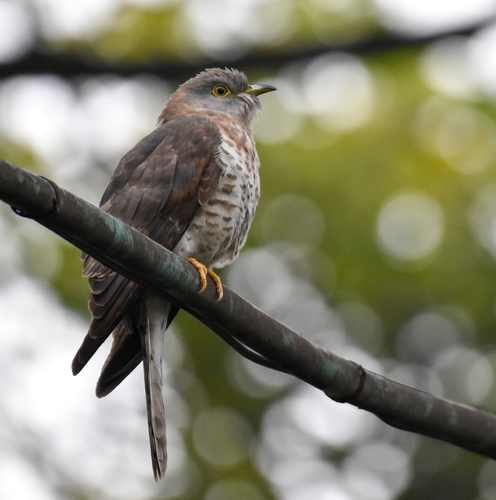
Common Hawk-Cuckoo
Hierococcyx varius
Famed for its piercing 'brain-fever' call and its incredible resemblance to a hawk, this clever cuckoo is a fascinating resident of backyards across South Asia. A master of disguise, it hides in plain sight while managing a complex life of brood parasitism.
Quick Identification
Size
34 cm (13.5 in) in length; wingspan of 55–60 cm (22–24 in); weight between 100–115g (3.5–4.0 oz)
Colors
Upperparts are ashy grey; underparts are whitish with rufous-brown barring; tail has dark and light bands with a pale tip; yellow eye-ring and bright yellow gape.
Key Features
- Striking resemblance to the Shikra hawk
- Distinctive 'brain-fever' three-note ascending call
- Yellow eye-ring and facial skin
- Banded tail with a broad dark subterminal band
When You’ll See Them
Geographic range
Where Does the Common Hawk-Cuckoo Live?
This species is a quintessential resident of the Indian Subcontinent, with a range that stretches from the Indus valley in Pakistan across the entirety of India, Nepal, and Bhutan, down to Bangladesh and Sri Lanka. It thrives in various landscapes, from the humid tropical plains to the temperate foothills of the Himalayas. Because it relies on specific host species like the Jungle Babbler, its presence is usually tied to areas where these hosts are common, including well-wooded suburban neighborhoods and rural village groves.
Basemap © OpenStreetMap contributors
Behavior
The Common Hawk-Cuckoo is a master of mimicry, but unlike other birds that mimic sounds, this cuckoo mimics the appearance and flight style of the Shikra, a local bird of prey. By looking like a hawk, it strikes fear into smaller birds, causing them to flush from their nests and allowing the cuckoo to swoop in and lay its parasitic eggs. They are largely solitary and spend much of their time perched motionless in high, leafy canopies, making them difficult to spot despite their loud presence.
During the breeding season, they are famous for their relentless calling, which has earned them the nickname 'Brainfever Bird.' The three-note call repeats and rises in pitch and volume until it reaches a crescendo, often continuing well into the night. While they are shy around humans, they are common in suburban areas where there is enough tree cover, often using backyard trees as staging grounds for their brood parasitic activities.
EverydayEarth exclusive
Camera Tips
To successfully capture the Common Hawk-Cuckoo on an AI-powered camera, you must think like a hawk. These birds prefer high-vantage perches on the edges of clearings. Mount your camera at least 8 to 12 feet high, angled slightly upward toward horizontal branches that provide a clear view of the surrounding area. They often use the same 'song posts' daily, so if you hear one calling repeatedly from a specific tree, that is your primary target for placement.
Since these birds are brood parasites, the best 'lure' isn't food, but the presence of their host species. If you have Jungle Babblers or laughingthrushes visiting your yard, place your camera near their nesting sites or communal feeding areas. The Common Hawk-Cuckoo will often lurk nearby, observing the host's movements. Because they are shy and prefer dense foliage, try to position the camera so it looks through a 'window' in the leaves toward a likely perch.
While they are mostly active during the day, the Common Hawk-Cuckoo is notoriously vocal and active at night during the summer months. Ensure your camera's night vision or infrared settings are optimized. A high-sensitivity PIR (Passive Infrared) sensor setting is essential, as these birds can remain very still for long periods before making a sudden, hawk-like dash. If your camera allows for video, set it to record at least 15-20 seconds to capture their characteristic tail-fanning and head-bobbing behaviors.
Similar Species
Species that look similar or are commonly confused with Common Hawk-Cuckoo.
Shikra
A true bird of prey with a more hooked beak, stouter legs, and more upright perching posture compared to the cuckoo.
Common Cuckoo
Lacks the hawk-like rufous barring on the breast and has a different, two-note 'cu-coo' call.
Large Hawk-Cuckoo
Noticeably larger with a heavier bill and more distinct streaking on the throat.
Frequently Asked Questions
Record Common Hawk-Cuckoo at your habitat
Connect a camera to start building your own species record — AI identifies every visitor automatically.