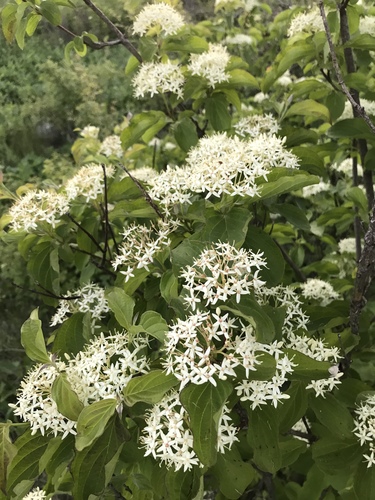
common dogwood
Cornus sanguinea
A champion of the hedgerow, the common dogwood dazzles with fire-red winter stems and serves as a bustling hub for birds and pollinators alike.
Quick Identification
Size
A deciduous shrub reaching 2 to 6 metres (6.5 to 20 feet) in height with a spread of 2 to 4 metres (6.5 to 13 feet).
Colors
Dull green leaves that turn deep purple-red in autumn; creamy white flowers; blood-red or burgundy winter stems; small black berries.
Key Features
- Striking blood-red or purple twigs in winter
- Opposite, oval leaves with 3-5 pairs of curving veins
- Clusters of small, 4-petaled creamy white flowers
- Small, bitter black berries known as dogberries
- Dense, suckering growth habit forming thickets
When You’ll See Them
Geographic range
Where Does the common dogwood Live?
The common dogwood is primarily native to Europe and Western Asia, with a distribution that stretches from the British Isles and Scandinavia in the west, all the way to the Caspian Sea and the Caucasus mountains in the east. It is a staple of the European countryside, particularly in temperate regions where it dominates hedgerows and woodland margins. While native to these regions, it has also been widely introduced to North America as an ornamental plant, where it occasionally escapes gardens to naturalize in similar temperate climates.
Basemap © OpenStreetMap contributors
Behavior
Common dogwood is a hardy, deciduous shrub that plays a vital role in its ecosystem through its dramatic seasonal cycles. In spring and early summer, it produces dense clusters of nectar-rich flowers that serve as a primary food source for a variety of pollinators, including bees, hoverflies, and the green hairstreak butterfly. As the season progresses, it forms thick, leafy cover that provides ideal nesting sites for songbirds and shelter for small mammals.
As a 'suckering' shrub, it naturally spreads via underground runners, often forming expansive colonies that help stabilize soil on slopes and riverbanks. In the autumn, its leaves undergo a stunning transformation into deep shades of purple and red before falling to reveal the plant's most iconic trait: its vibrant red winter bark. This winter color is a survival strategy, as the bright pigment (anthocyanin) helps protect the plant's delicate tissues from cold stress and light damage.
EverydayEarth exclusive
Camera Tips
Setting up a backyard camera to monitor common dogwood is a fantastic way to capture the high volume of bird life it attracts. To get the best results, position your camera at a mid-level height (around 1 meter or 3 feet) and aim it directly at the outer branches where berries are most abundant. During September and October, you'll want a fast trigger speed to capture the rapid movements of thrushes, starlings, and blackcaps as they feast on the black dogberries.
In the winter months, the dogwood’s red stems provide an exceptional high-contrast backdrop for wildlife photography. Place your camera to face the shrub from the south to take advantage of the low winter sun, which makes the red bark glow. This is the best time to catch small garden birds like Robins or Blue Tits perching among the branches. Because dogwood grows quite densely, try to find a natural 'opening' in the foliage to focus your camera, ensuring you don't have too many foreground twigs that might cause the autofocus to hunt or trigger the motion sensor unnecessarily.
If you are interested in the plant's growth cycle, common dogwood is a perfect subject for long-term time-lapse projects. Secure your camera to a permanent post and set it to take one or two photos a day from April through June. This will allow you to document the incredible transition from bare red winter sticks to a lush green shrub exploding with creamy white blossoms. For insect enthusiasts, use a camera with macro capabilities during the peak flowering weeks of May and June, focusing on a single flower cluster during the warmest part of the day to capture visiting pollinators.
Similar Species
Species that look similar or are commonly confused with common dogwood.
Frequently Asked Questions
Record common dogwood at your habitat
Connect a camera to start building your own species record — AI identifies every visitor automatically.