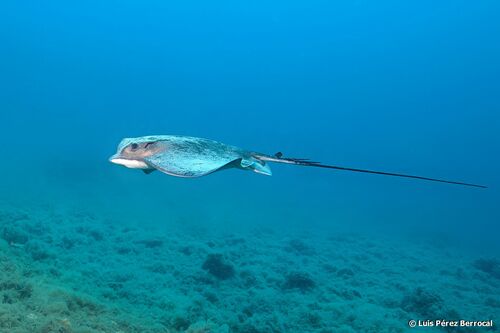
Common Eagle Ray
Myliobatis aquila
The Common Eagle Ray is the ocean's version of a soaring bird, gliding through coastal waters with effortless grace. With its unique bull-like snout and powerful wingspan, this critically endangered ray is a majestic find for any underwater camera enthusiast.
Quick Identification
Size
Wingspan typically ranges from 60 to 100 cm (2 to 3.3 ft), though large individuals can reach up to 183 cm (6 ft); weight usually caps at around 15 to 30 kg (33 to 66 lbs).
Colors
Uniformly dark brown, bronze, or olive-grey on the upper side (dorsal); creamy white on the underside (ventral) with no distinct spots or markings.
Key Features
- Broad wing-like pectoral fins with pointed tips
- Protruding snout resembling a bull’s head
- Long whip-like tail with a small dorsal fin and venomous spine
- Graceful 'flying' swimming motion using pectoral fin flapping
When You’ll See Them
Geographic range
Where Does the Common Eagle Ray Live?
The Common Eagle Ray is primarily native to the temperate and subtropical waters of the eastern Atlantic Ocean and the Mediterranean Sea. Its range begins as far north as the southern British Isles and Norway, stretching down the coast of Africa to South Africa. It also inhabits the south-western Indian Ocean, where it is frequently found in the coastal waters of South Africa and Mozambique.
Basemap © OpenStreetMap contributors
Behavior
Common Eagle Rays are celebrated for their elegant, bird-like swimming style. Unlike many other rays that lie flat on the bottom, Eagle Rays are active swimmers that 'fly' through the water column by flapping their powerful pectoral fins. They are frequently found in small groups or large schools, especially during migrations or the summer breeding season. While they are often seen near the surface, they are also highly efficient bottom-feeders, diving to the seafloor to forage for hidden prey.
These rays are generally shy and wary of humans, usually fleeing at the first sign of a predator or a noisy swimmer. However, they are known to be quite curious about stationary objects, which makes them excellent subjects for fixed underwater cameras. They possess a venomous spine at the base of their tail, but this is used purely for defense and the species is considered non-aggressive toward humans unless handled or stepped upon.
EverydayEarth exclusive
Camera Tips
Capturing a Common Eagle Ray on camera requires a specialized approach since they are entirely aquatic. For those with 'backyard' access to a dock, pier, or beachfront, an underwater action camera (like a GoPro) or a dedicated marine trail camera is essential. Mount your camera to a dock piling or a weighted tripod on the seafloor at a depth of 1 to 3 meters. Angle the lens slightly downward to capture the rays as they glide over the sand looking for food, or set it horizontally to catch their 'wing' movements as they swim past.
To lure these rays into the frame, look for areas with natural food sources like oyster beds or sandy patches rich in shellfish. You can enhance your chances by using a 'scent bag'—a mesh pouch filled with crushed oily fish or squid—tethered just out of the camera's view. The rays' sensitive electro-receptors and keen sense of smell will draw them toward the area to investigate the source of the vibrations and scent.
Timing is critical for clear footage. Aim to record during the hour before and after high tide, when the water is typically at its clearest and the rays are more likely to move into shallow, near-shore areas. If your camera supports it, use a high frame rate (60fps or higher) to capture the fluid, hypnotic motion of their fins. Ensure your housing is cleaned of algae regularly and use a tether for security, as tidal currents can be surprisingly strong.
Similar Species
Species that look similar or are commonly confused with Common Eagle Ray.
Frequently Asked Questions
Record Common Eagle Ray at your habitat
Connect a camera to start building your own species record — AI identifies every visitor automatically.