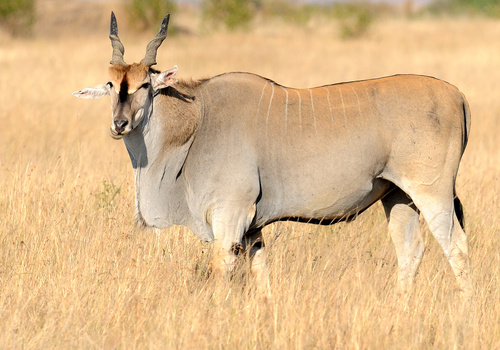
Common Eland
Tragelaphus oryx
Meet the Common Eland, a gentle giant of the African savanna that combines the power of a bull with the grace of an antelope. Known for its massive spiral horns and the ability to jump staggering heights, this docile herbivore is a true heavyweight of the wild.
Quick Identification
Size
Height: 1.4–1.6 m (4.6–5.2 ft) at shoulder; Weight: 340–942 kg (750–2,077 lb)
Colors
Tan or fawn coat with thin white vertical stripes; males turn bluish-grey with age and have a dark tuft of hair on the forehead.
Key Features
- Massive spiral horns present in both sexes
- Large, loose fold of skin (dewlap) hanging from the throat
- Faint white vertical stripes on the flanks
- Noticeable clicking sound from hooves when walking
- Stocky, bovine-like build with a hump on the shoulders
When You’ll See Them
Sightings on EverydayEarth
Jun 29, 2026
A Plains Zebra and two Common Elands are seen moving across a dry, grassy landscape. The zebra walks steadily to the right while the elands graze and pause to look around the open field near the water's edge.
Jun 17, 2026
A large Common Eland stands quietly in the dappled shade of a woodland area. It shifts its weight and eventually begins to move slowly to the right, partially obscured by a thicket of trees. A second individual is faintly visible in the background to the left, mostly hidden by vegetation.
Jun 11, 2026
An adult female Common Eland stands in the woodland shade while her calf nurses. Several oxpeckers are perched on the adult's back, moving along her neck and spine to groom for parasites. The adult remains mostly still, occasionally turning her head to scan the environment.
Jun 11, 2026
In the dappled shade of the woodland, a female Common Eland stands quietly while her calf nurses. Several oxpeckers are perched on the mother's back and neck, likely feeding on parasites. In the background, an Olive Baboon is visible sitting and foraging in the grass.
Jun 8, 2026
A diverse group of African herbivores is gathered in a grassy woodland clearing near a waterhole. Several Common Wildebeest graze in the foreground and mid-ground, while a group of Common Eland—the world's largest antelopes—feed nearby. On the far right, a solitary Impala is visible grazing at the edge of the vegetation. The animals appear calm and are focused on feeding in the bright daylight.
May 12, 2026
A Grevy's zebra stands in a verdant clearing, occasionally lowering its head to graze. A small bird is perched on the zebra's rump, likely searching for insects. In the background, a small group of eland grazes near the edge of the woodland.
Geographic range
Where Does the Common Eland Live?
The Common Eland is native to the vast sun-drenched landscapes of East and Southern Africa. Its core populations are found across a massive belt stretching from Ethiopia and South Sudan down through Kenya, Tanzania, and Zambia, reaching its highest densities in the protected parks and private reserves of South Africa, Namibia, and Botswana. While they have been extirpated from some historical ranges due to habitat loss, they remain one of the most widely distributed large antelopes on the continent.
Basemap © OpenStreetMap contributors
Behavior
Common Elands are the world's second-largest antelope, characterized by a surprisingly docile and social temperament. They are gregarious animals, forming herds that can range from a few dozen individuals to several hundred during the lush rainy season. Unlike many of their cousins, they are not strictly territorial and prefer to wander across expansive home ranges, with adult males often forming bachelor groups or living solitary lives until the breeding season begins.
One of the most remarkable behaviors of the eland is its agility. Despite weighing nearly a ton, an adult eland can leap over a 2.5-meter fence from a standing start. They are primarily crepuscular, spending the hottest parts of the African day resting in the shade and becoming active during the cooler morning and evening hours. While they are naturally wary of predators, they have been known to stand their ground collectively to protect calves from hyenas or leopards.
EverydayEarth exclusive
Camera Tips
Capturing the Common Eland on camera requires positioning your equipment to accommodate their immense scale. Because an adult male can stand over five feet at the shoulder, mount your camera at chest height—roughly 1.2 to 1.5 meters—rather than the standard knee-height used for smaller game. If you place the camera too low, you may only capture the animal's legs and underbelly, missing the impressive spiral horns and facial markings that make this species so iconic.
Elands are most active during the transition hours of dawn and dusk. To get the best shots, focus your efforts on game trails that lead from thick cover to open water sources or known mineral licks. If you are monitoring a large property or conservancy, providing a salt block is the most effective way to attract them to a specific frame. Use 'No-Glow' infrared flash settings; while elands are generally calm, they are sensitive to the 'red glow' of standard IR cameras, which can cause the herd to avoid the area in the future.
During the dry season, elands are much more predictable and will frequent permanent water holes daily. Set your camera to 'burst mode' or high-definition video. Elands often travel in single-file lines or tight clusters; a single photo might only catch the nose of the lead cow or the tail of the last bull. Video is particularly rewarding because it can capture the unique 'clicking' sound produced by their hooves as they walk, a detail that adds a layer of professional quality to your wildlife monitoring.
Similar Species
Species that look similar or are commonly confused with Common Eland.
Frequently Asked Questions
Record Common Eland at your habitat
Connect a camera to start building your own species record — AI identifies every visitor automatically.