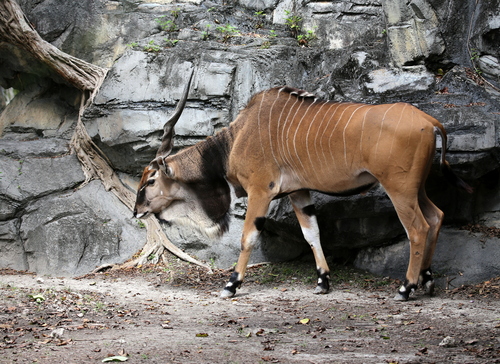
Giant Eland
Mammals Most active at dawn and dusk

Giant Eland

Tragelaphus derbianus

Meet the world's largest antelope, a spiraled-horn giant that roams the African savannas with surprising grace. Rare, elusive, and nomadic, the Giant Eland is the ultimate discovery for any wildlife enthusiast.

0 Sightings
0 Habitats

Quick Identification

straighten

Size

Length: 220–290 cm (7.2–9.5 ft); Weight: 300–1,000 kg (660–2,200 lbs); Height at shoulder: 1.5–1.8 m (4.9–5.9 ft)

palette

Colors

Reddish-brown or chestnut coat with 8–15 vertical white stripes; older males develop a slate-grey hue and a dark ruff on the neck.

visibility

Key Features

  • Massive V-shaped spiraled horns reaching up to 1.2 meters
  • Large skin fold (dewlap) hanging from the throat
  • 8-15 thin white vertical stripes on the torso
  • Prominent black markings on the back of the forelegs
add_a_photo
Is this a Giant Eland?

Drop a photo or video, or paste from clipboard

When You’ll See Them

schedule
Activity pattern Most active at dawn and dusk
brightness_5
Peak hours 5-8 AM, 5-8 PM
calendar_month
Season Dry season (November-May) for higher visibility near water holes
restaurant
Diet Primarily a browser that consumes leaves, succulent shoots, and wild fruits. They use their powerful horns to break high branches and their long, prehensile tongues to strip foliage.
park
Habitat Open woodlands, broad-leaved savannas, and forest edges, almost always within reach of a reliable water source.

public Geographic range

Where Does the Giant Eland Live?

The Giant Eland is a majestic resident of the African continent, primarily found across the broad-leaved savannas of West and Central Africa. Its native range exists in two distinct pockets: the Western subspecies lives in Senegal, while the larger Eastern population stretches through Cameroon, the Central African Republic, and into South Sudan. This species avoids deep rainforests and true deserts, preferring the 'Goldilocks' zone of wooded grasslands where cover and forage are both plentiful.

Basemap © OpenStreetMap contributors

8 Countries
500K km² Range
Vulnerable Conservation
SN Senegal Central African Republic Cameroon South Sudan Chad Guinea Mali NG Nigeria
eco
iNaturalist / Verified observation data
View on iNaturalist open_in_new

Explore more Mammals arrow_forward

Behavior

Giant Elands are highly social yet notoriously elusive, typically forming herds of 15 to 25 individuals. Unlike many other large bovids, they are primarily nomadic, moving across vast territories to follow the seasonal growth of fresh vegetation and availability of water. They are famous for their jumping ability; despite their massive size, they can leap over obstacles up to 1.5 meters high from a standing start.

These antelopes are crepuscular, meaning they are most active during the cooler hours of dawn and dusk, retreating into thick woodland cover to rest during the heat of the day. They are extremely wary of humans and will flee at the slightest sign of danger, often covering several kilometers once startled. Within the herd, there is a clear hierarchy, especially among males who use their impressive horns for wrestling matches rather than goring to establish dominance.

photo_camera EverydayEarth exclusive

Camera Tips

To capture the world's largest antelope, camera placement is everything. Because Giant Elands are significantly taller than most backyard wildlife, you must mount your camera much higher than usual—ideally at chest height (around 4–5 feet) on a sturdy tree. Angle the lens slightly downward to ensure you capture the full body and those magnificent spiraled horns, rather than just a patch of hide. Since they are notoriously shy, avoid placing cameras in wide-open clearings; instead, target dense 'funnels' where woodland meets water or known salt licks.

If you are on a large property or ranch where they roam, mineral blocks or salt licks are the most effective lures, as these nomadic grazers will detour significantly to find essential nutrients. Ensure your camera is set to a fast trigger speed and use 'Burst Mode.' These animals move with a surprisingly long stride, and a single photo often results in a 'half-animal' shot. A 3-5 photo burst ensures you get a clear look at the facial markings and stripes for individual identification.

Video mode is particularly rewarding for Giant Elands. Use 20-30 second clips to capture the unique 'clicking' sound their hooves make—a rhythmic sound caused by the two halves of their heavy hooves hitting each other as they lift their feet. Because they are most active during the twilight hours, ensure your camera has high-quality infrared (no-glow) LEDs. Standard white-flash cameras will almost certainly spook the herd, causing them to abandon the area for weeks.

Frequently Asked Questions

Giant Elands are crepuscular, meaning they are most active during the twilight hours of dawn and dusk. They typically feed and travel between 5:00 AM and 8:00 AM, and again in the late afternoon, while spending the hottest part of the day resting in the shade of thickets.
The most effective way to attract Giant Eland is by placing your camera near natural salt licks or providing mineral blocks. In their native African range, they are also highly attracted to water sources during the dry season. High-quality infrared cameras are essential to avoid spooking them with visible light.
They are strictly browsers. Their diet consists of leaves, green shoots, and fruits from various trees and shrubs. They are known to use their heavy horns to hook and break high branches that are otherwise out of reach.
No, Giant Elands are not found in suburban environments. They require large, undisturbed tracts of savanna and woodland. They are extremely shy and generally avoid areas with high human activity or significant noise.
The Giant Eland is larger and has much longer, more widely spread horns. Look at the neck: the Giant Eland has a dark 'collar' of hair and many more vertical white stripes (up to 15) compared to the Common Eland, which often has fewer or fainter stripes.

Record Giant Eland at your habitat

Connect a camera to start building your own species record — AI identifies every visitor automatically.

Join free Identify a photo