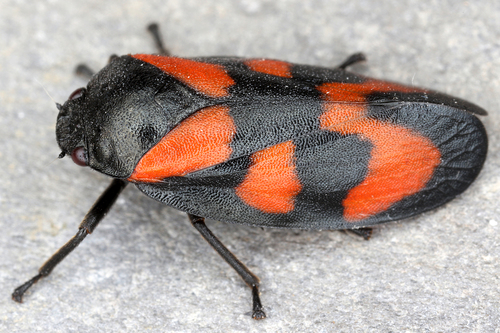
Common Froghopper
Cercopis vulnerata
With its bold black-and-red 'racing livery,' the Common Froghopper is one of the most stylish insects in the backyard. Don't let their small size fool you—they are champion jumpers capable of incredible aerial feats.
Quick Identification
Size
9–11 mm (0.35–0.43 inches) in length
Colors
Striking jet-black body and wings with three bold, bright red spots on each forewing
Key Features
- Bold red and black warning coloration
- Tent-like wing position at rest
- Enlarged, powerful hind legs built for jumping
- Robust, shield-shaped thorax
When You’ll See Them
Behavior
The Common Froghopper (specifically the Black-and-Red variety) is a master of escape. While they spend much of their time calmly perched on plant stems, they are famous for their explosive jumping ability. When threatened, they use their powerful hind legs to catapult themselves many times their own body length into the air, often vanishing before a predator—or a camera—can react.
Unlike their nymph counterparts, which hide inside bubbles of 'cuckoo spit,' the adults rely on their vibrant colors to signal to birds that they are distasteful. They are solitary insects, though you may find several sharing a particularly sap-rich host plant. They do not bite or sting and are entirely harmless to humans, spending their short adult lives looking for mates and high-quality plant fluids.
EverydayEarth exclusive
Camera Tips
Capturing high-quality images of the Common Froghopper requires a specialized approach because of their small size. Most standard backyard trail cameras have a minimum focus distance of several feet, which is too far for a 10mm insect. To get the best results, use an AI-powered camera with a macro lens or a 'close-up' adapter. Position the camera just 6 to 10 inches away from vertical plant stems, such as nettles, thistles, or young willow branches, which are their preferred perching spots.
Placement is everything. Look for south-facing garden edges where the morning sun hits the vegetation; these insects are cold-blooded and will often bask in the sun to warm up their flight muscles. Mount your camera on a steady stake or flexible arm to prevent wind from shaking the foliage out of the frame. If your camera has a 'small animal' or 'insect' sensitivity setting, turn it to the highest level, as the movement of a froghopper is subtle until they decide to jump.
To increase your chances of a sighting, create a 'macro station' by allowing a small patch of native weeds or tall grass to grow undisturbed. Since they aren't attracted to traditional baits, your lure is the habitat itself. If you are using a camera that records video, set it to a high frame rate (at least 60fps). This is the only way to effectively capture their lightning-fast leaps, which occur in a fraction of a second and are often missed by the human eye.
Similar Species
Species that look similar or are commonly confused with Common Froghopper.
Frequently Asked Questions
Record Common Froghopper at your habitat
Connect a camera to start building your own species record — AI identifies every visitor automatically.