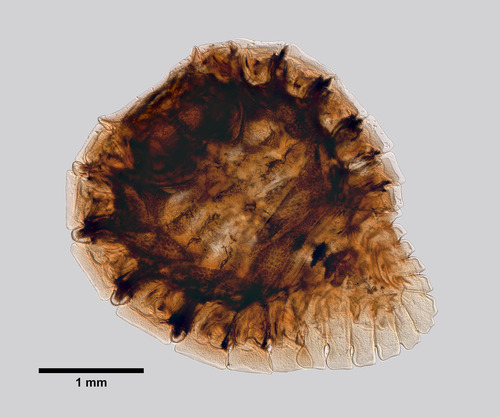
Common Glass Shrimpeater
Probopyrus pandalicola
A master of internal disguise, the Common Glass Shrimpeater is a parasitic wonder that transforms the look of common coastal shrimp. Tucked away in the gills of its host, this isopod is a fascinating example of the hidden 'mini-monsters' living in our coastal estuaries.
Quick Identification
Size
Females reach 3–5 mm (0.12–0.2 in); males are significantly smaller at 1–2 mm (0.04–0.08 in).
Colors
Translucent white or pale yellow; females often show dark digestive organs through the cuticle; males are nearly colorless.
Key Features
- Distinctive bulge on the side of a host shrimp's carapace
- Asymmetrical, distorted body shape in females
- Resides exclusively within the gill chamber of grass shrimp
- Small, flatter male often attached to the female's underside
When You’ll See Them
Geographic range
Where Does the Common Glass Shrimpeater Live?
Native to the Western Atlantic coastline, the Common Glass Shrimpeater is found from the temperate waters of southern New Hampshire down through the mid-Atlantic and the Gulf of Mexico. Its range extends significantly into the Caribbean and follows the South American coastline as far south as Brazil. As an estuarine specialist, it is most common in the nutrient-rich, brackish waters of coastal marshes and mangroves where its host species congregate.
Basemap © OpenStreetMap contributors
Behavior
The Common Glass Shrimpeater is a highly specialized parasitic isopod that spends its adult life tucked away inside the gill (branchial) chamber of various grass shrimp species. Unlike free-swimming isopods, the female Shrimpeater becomes sedentary once it finds a host, slowly growing and molding its body to fit the curve of the shrimp's carapace. This creates a very noticeable, cyst-like swelling on the shrimp, often referred to as a 'shrimp cheek.' While they do not kill their hosts immediately, they act as energy sinks, feeding on the shrimp's hemolymph.
Interestingly, these parasites exhibit a complex social and reproductive dynamic. A large female typically occupies the gill chamber alone, while a tiny, more traditionally shaped male lives as a 'hitchhiker' attached to her pleon. Their presence effectively castrates the host shrimp, preventing it from reproducing and redirecting all that potential energy into the parasite's own egg production. Because they are permanent residents, their 'behavior' is entirely tied to the movements and survival of their host.
EverydayEarth exclusive
Camera Tips
Capturing the Common Glass Shrimpeater on camera is a masterclass in macro photography. Since this species lives inside the gills of the transparent Grass Shrimp, you aren't looking for the parasite itself, but the 'bulge' it creates. To succeed, you need an underwater housing or a very clear aquarium setup near a dock. Position your camera at a side-profile angle relative to the water's edge where shrimp congregate in the shadows of seagrass or pilings. A macro lens with at least a 1:1 magnification ratio is essential to resolve the parasite through the host's translucent shell.
Lighting is your biggest challenge and your best friend. Use a high-intensity underwater LED side-light or a ring flash to highlight the host shrimp's carapace. Because the shrimp are nearly transparent, 'backlighting' them can make the opaque body of the Common Glass Shrimpeater stand out as a dark or yellowish mass inside the gill chamber. Set your camera to a fast shutter speed (1/250s or higher) because even though the parasite is stationary, the shrimp host moves with erratic, jerky pulses that can easily cause motion blur.
For the best results, place your camera near submerged vegetation during a rising tide. This is when Grass Shrimp are most active and likely to move into the frame. Look for a 'deformed' shrimp; if one side of its head looks swollen or asymmetrical, you have found your target. High-resolution video (4K) is often better than stills for this species, as it allows you to see the rhythmic pulsing of the parasite's pleopods (swimmerets) as it circulates water through the host's gill chamber.
Similar Species
Species that look similar or are commonly confused with Common Glass Shrimpeater.
Frequently Asked Questions
Record Common Glass Shrimpeater at your habitat
Connect a camera to start building your own species record — AI identifies every visitor automatically.