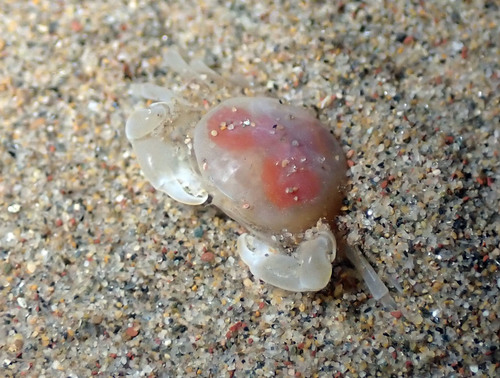
Pea Crab
Pinnotheres pisum
A tiny, translucent squatter that makes its home inside the shells of mussels and oysters. The Pea Crab is a master of the hidden lifestyle, living as a gentle thief in the coastal intertidal zone.
Quick Identification
Size
Females reach 6–15 mm (0.2–0.6 in) in width; males are smaller, typically 3–7 mm (0.1–0.3 in).
Colors
Translucent creamy-white, pale pink, or yellowish; females often have a visible orange or red egg mass under the abdomen.
Key Features
- Soft, rounded, pea-shaped body in females
- Translucent or semi-opaque shell
- Lives exclusively inside bivalve mollusks
- Tiny, reduced eyes and slender legs
- Harder, flatter shell in the much smaller males
When You’ll See Them
Geographic range
Where Does the Pea Crab Live?
The Pea Crab is a native inhabitant of the temperate waters of the Eastern Atlantic Ocean and the Mediterranean Sea. Its range extends from the northern reaches of Scandinavia and the British Isles down through the Atlantic coasts of France, Spain, and Portugal, reaching as far south as the North African coastline. In these regions, it is a common resident of estuaries and coastal bays wherever dense populations of its primary hosts, like the blue mussel, are present.
Basemap © OpenStreetMap contributors
Behavior
The Pea Crab is a fascinating example of a kleptoparasite, a creature that lives by stealing food from its host. Unlike most crabs that roam the seafloor, the female Pea Crab spends nearly her entire adult life encased within the shell of a living bivalve, such as a mussel, oyster, or cockle. She positions herself near the host's gills, where she uses her specialized legs to intercept strings of nutrient-rich mucus and plankton that the host filters from the water. Because she is so well-protected by the host's shell, her own carapace remains soft and rounded, as she has little need for heavy armor.
Socially, Pea Crabs are largely solitary within their hosts, though occasionally two may share a single large mollusk. The smaller males are more active and mobile than the females; they possess a harder shell that allows them to leave their host and swim through open water to find a female in another bivalve for mating. While they do not usually kill their host, they can cause minor gill damage and reduced growth rates in the bivalve by consuming its food supply. For humans, they are most often encountered as a surprise discovery when shucking fresh seafood, often considered a sign of a healthy, clean environment.
EverydayEarth exclusive
Camera Tips
Capturing the Pea Crab on a backyard trail camera is a unique challenge because their 'backyard' is the intertidal zone and the interior of other animals. To document them, you will need an underwater camera setup or a specialized macro lens. If you live near a coast, the best strategy is to focus on tide pools during a very low tide. Look for large, healthy mussel beds or oyster clusters. While you won't see the female crab without opening a shell, you can place a waterproof camera on a small tripod directed at an open, feeding mussel. With patience and high-resolution video settings, you may see the tiny legs of a Pea Crab poking out near the shell's edge as it feeds.
Lighting is the most critical factor for these translucent creatures. Use a side-lighting technique with a waterproof LED panel to highlight the crab's internal structures and soft shell. If you are using a macro lens in a controlled environment, such as a salt-water aquarium featuring local species, set your camera to a wide aperture (low f-stop) to create a soft background that makes the pale crab pop. Because they move slowly, a shutter speed of 1/125 is usually sufficient for stills, but use 60fps or higher for video to capture the delicate movement of their legs.
For those interested in the mobile males, seasonal timing is everything. During the late spring and summer, males leave their hosts to find mates. You can sometimes capture this 'host-hopping' behavior by setting up a camera near a cluster of mussels at night with a gentle, red-filtered light source to avoid scaring them. Always ensure your gear is thoroughly rinsed with fresh water after exposure to salt spray or submersion to prevent corrosion. This species offers a rare opportunity to showcase the 'hidden' side of backyard wildlife that most people never see.
Similar Species
Species that look similar or are commonly confused with Pea Crab.
Frequently Asked Questions
Record Pea Crab at your habitat
Connect a camera to start building your own species record — AI identifies every visitor automatically.