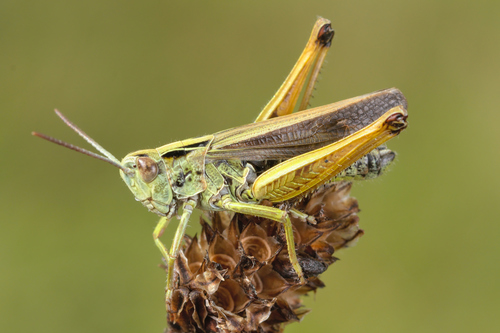
Common Green Grasshopper
Omocestus viridulus
A vibrant icon of the summer meadow, the Common Green Grasshopper is famous for its long, ticking song and striking emerald hues. It is a master of the vertical world, spending its days basking and leaping through damp, lush grasses.
Quick Identification
Size
13-15 mm (0.5-0.6 inches) for males; 17-20 mm (0.7-0.8 inches) for females.
Colors
Typically bright grass-green on top and sides, though some females may have brown or purplish flanks. Males often feature an orange-red tip on the abdomen.
Key Features
- Distinctive 'S' shaped or sharply indented side-keels on the pronotum
- Uniformly green dorsal surface in most individuals
- Wings that usually extend to or just beyond the tip of the abdomen
- Male song is a loud, rhythmic ticking that lasts 10-20 seconds
When You’ll See Them
Geographic range
Where Does the Common Green Grasshopper Live?
This species is native to the Palearctic region, boasting a massive range that stretches from the British Isles and Western Europe all the way across Northern Asia to the Pacific coast. It is particularly prevalent in Northern and Central Europe, including Scandinavia, where it thrives in cooler, damper conditions than many of its cousins. While it is widely distributed across Russia and parts of Northern China, it has not been introduced to North America or the Southern Hemisphere.
Basemap © OpenStreetMap contributors
Behavior
The Common Green Grasshopper is one of the most familiar insects of the summer countryside, known for being one of the first species to mature and begin 'singing' in early June. They are highly active during the day, relying on the sun's warmth to provide the energy needed for their impressive leaps and flight. When disturbed, they use their powerful hind legs to catapult themselves into thick vegetation, often flying a short distance to evade predators.
Socially, the species is best known for the male's stridulation—a song produced by rubbing the hind legs against the forewings. This song starts quietly and builds into a rapid, mechanical ticking that is a key indicator of their presence in a garden or field. Unlike some more aggressive insects, they are peaceful herbivores that spend the majority of their time basking and feeding on local grasses.
EverydayEarth exclusive
Camera Tips
Capturing the Common Green Grasshopper on an AI-powered camera requires a specific setup due to their small size and preference for vertical stalks. To get high-quality images, use a macro-capable lens or a camera with a very short minimum focus distance. Position the camera low to the ground, aiming it at a cluster of sun-drenched grass or a flat stone where they may go to bask during the morning hours. An upward angle often provides a clearer silhouette against the sky, helping the AI identify the insect's distinct shape.
Because these insects are triggered by heat, your camera will be most successful on bright, sunny days. Avoid placing cameras in deep shade or high-traffic areas where human footsteps might cause them to jump away before the shutter triggers. Using a 'fast trigger' setting is vital; grasshoppers are incredibly quick, and a slow camera might only capture a blurred leg or an empty blade of grass where the insect sat just milliseconds before.
To encourage them to land in front of your lens, you can create a 'stage' by clearing a small patch of grass and leaving a few prominent, vertical stalks in the center. They naturally climb these to sing and survey their surroundings. While they aren't attracted to traditional baits like mammals are, ensuring your camera is in a damp area with lush growth will naturally draw them in. Check your camera's housing for moisture, as this species prefers humid environments that can sometimes fog up lenses in the early morning.
Similar Species
Species that look similar or are commonly confused with Common Green Grasshopper.
Frequently Asked Questions
Record Common Green Grasshopper at your habitat
Connect a camera to start building your own species record — AI identifies every visitor automatically.