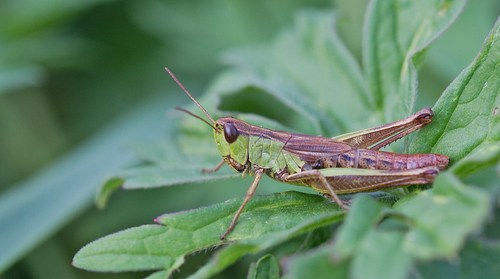
Meadow Grasshopper
Pseudochorthippus parallelus
The Meadow Grasshopper is the rhythmic soul of the summer garden, famous for its 'sewing-machine' song and vibrant green colors. Though it cannot fly, this tiny athlete is a master of camouflage and a staple of backyard wildlife watching.
Quick Identification
Size
13-22 mm (0.5 to 0.9 inches); females are notably larger and bulkier than males.
Colors
Typically vibrant green, olive, or straw-brown, though some individuals may appear pink or purple. They often feature a dark stripe behind the eye and dark 'knees' on the hind legs.
Key Features
- Short wings that do not reach the end of the abdomen
- Parallel side-ridges (carinae) on the pronotum
- Flightless in both sexes
- Males have a blunt, rounded end to the abdomen
When You’ll See Them
Behavior
The Meadow Grasshopper is a flightless inhabitant of the grass canopy, relying on its powerful hind legs to navigate through thick vegetation. Unlike many of its more mobile relatives, this species rarely travels far from its birthplace, making it a permanent and reliable resident of healthy suburban gardens. They are famous for their 'singing,' or stridulation, where males rub a row of tiny pegs on their hind legs against their wing cases to produce a rhythmic, 'sewing-machine' chirping sound to attract mates.
Highly dependent on temperature, these grasshoppers spend much of their morning basking on flat leaves or stones to absorb the sun's energy. In a typical backyard, they are surprisingly social and can be found in high densities where the grass is left long. They are cautious and will often spirally rotate around a grass stem to hide from an approaching human or camera, a behavior known as 'squirrel-heading.'
EverydayEarth exclusive
Camera Tips
To capture the Meadow Grasshopper on a backyard camera, you must think small and stay low. Position your AI-powered camera just 4 to 8 inches above the ground. The best placement is facing a 'highway' of vertical grass stems or a flat, sun-drenched stone where they are likely to bask in the morning. Since they are flightless, they follow predictable paths through the grass, so look for areas where different types of vegetation meet.
Macro settings are vital for this species. If your camera has a manual focus or a dedicated macro mode, set it to its closest possible range. Because these insects are triggered by warmth and light, aiming your lens at a patch of grass that catches the first morning light will maximize your chances of catching them while they are still sluggish from the night's cold. A sun-facing orientation (south-facing in the northern hemisphere) is usually the most productive.
You can create a 'basking stage' to lure them into frame. Placing a piece of dark wood or a flat, dark rock in a sunny spot surrounded by tall grass will encourage them to stop and sit for long periods. Avoid using traditional liquid lures, as they are not attracted to sugar; instead, focus on providing the perfect micro-climate. High-frame-rate video settings are recommended if you want to capture the rapid leg movements of a male 'singing' in mid-summer.
Late summer—specifically August and September—is the peak window for photography. This is when the adults are at their maximum size and most active. Early morning shots are particularly rewarding, as you can often catch them covered in dew, which provides a high-contrast subject that is easier for AI models to detect and identify accurately. Ensure the area immediately in front of the lens is clear of swaying grass blades that might cause false triggers on windy days.
Similar Species
Species that look similar or are commonly confused with Meadow Grasshopper.
Frequently Asked Questions
Record Meadow Grasshopper at your habitat
Connect a camera to start building your own species record — AI identifies every visitor automatically.