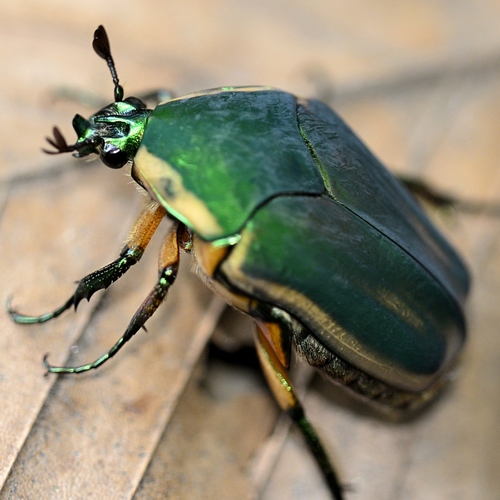
Common Green June Beetle
Cotinis nitida
A shimmering jewel of the summer sky, the Common Green June Beetle is famous for its velvet-green shell and its clumsy, buzzing flight through sunny backyard gardens.
Quick Identification
Size
20-25 mm (0.75-1.0 inches) long; robust, broad-bodied scarab shape
Colors
Dull velvet-green wing covers with brownish-yellow margins; underside is a brilliant, metallic iridescent green and gold
Key Features
- Dull, velvet-like green texture on the back
- Shiny metallic emerald or copper underbelly
- Flat, shield-like shape with a small horn-like ridge on the head
- Distinctive loud buzzing sound during flight
When You’ll See Them
Geographic range
Where Does the Common Green June Beetle Live?
The Common Green June Beetle is a native North American species primarily found throughout the eastern United States and southern Canada. Its population is most dense in the American South and Southeast, though it is commonly spotted as far north as the Great Lakes and as far west as the edge of the Great Plains. These beetles thrive in areas where moist, organic-rich soil is available for their underground larval development.
Basemap © OpenStreetMap contributors
Behavior
The Common Green June Beetle is well-known for its somewhat clumsy and erratic flight patterns. During the heat of the day, these beetles fly low to the ground with a loud, deep buzz that frequently leads people to mistake them for large bumblebees or carpenter bees. Despite their intimidating sound and size, they are harmless to humans and do not bite or sting.
These beetles are highly social when it comes to feeding. When a prime food source like a ripening peach or a fermenting pile of fruit is discovered, they will congregate in large numbers, often crawling over one another to reach the sugary juices. They are strictly diurnal, meaning they are active during the day and retreat to the safety of tall grass or shallow soil as the sun sets.
EverydayEarth exclusive
Camera Tips
To capture high-quality images of the Common Green June Beetle, focus your efforts on 'bait stations' rather than random sightings. These beetles are highly attracted to the scent of fermentation. Place a shallow dish filled with overripe peaches, smashed grapes, or even a mix of molasses and beer in a sun-drenched area of your yard. Position your camera about 12 to 18 inches away from the bait to catch the fine details of their velvet-textured shells.
Because these beetles are most active in the intense midday sun, you don't need to worry about low-light settings. However, their metallic underbellies are highly reflective, which can sometimes 'blow out' an image with glare. If your camera allows for exposure adjustment, slightly underexposing the shot can help preserve the rich emerald and gold colors seen when the beetle flips over or takes flight.
Since they are fast and erratic flyers, use a high shutter speed or a 'Burst' mode to capture the moment of landing. These beetles are relatively heavy and 'crash-land' onto their food, providing a split second where they are stationary before they begin burrowing into the fruit. Mounting your camera on a small tripod at a 45-degree angle to the bait will help capture both the dull green back and the flashy metallic underside.
Similar Species
Species that look similar or are commonly confused with Common Green June Beetle.
Figeater Beetle
Found primarily in the Southwestern US; lacks the dull velvet texture of the Green June Beetle and is typically more iridescent on top.
Japanese Beetle
Much smaller (about half the size) with metallic copper-colored wing covers and distinct white tufts of hair along the sides of the abdomen.
Frequently Asked Questions
Record Common Green June Beetle at your habitat
Connect a camera to start building your own species record — AI identifies every visitor automatically.