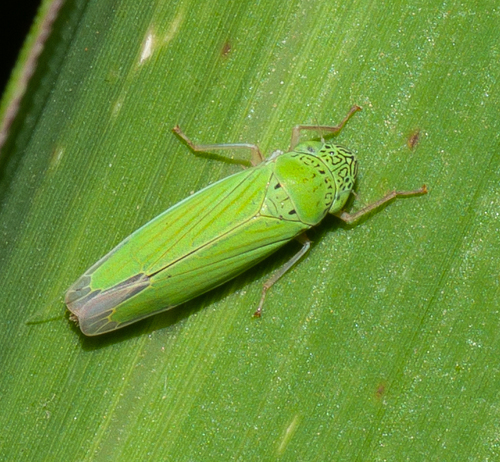
Common Green Leafhopper
Hortensia similis
Meet the emerald acrobat of your lawn. The Common Green Leafhopper is a vibrant, wedge-shaped marvel known for its geometric head patterns and its ability to vanish in the blink of an eye.
Quick Identification
Size
Length of 4.5–6 mm (0.18–0.24 inches)
Colors
Vibrant emerald green body; the head and thorax feature distinct black and pale yellow-green geometric markings; wings are translucent green.
Key Features
- Bright leaf-green, wedge-shaped body
- Intricate black 'mosaic' or 'maze' markings on the crown of the head
- Strong, spine-covered hind legs adapted for jumping
- Large, prominent eyes set to the sides of the head
When You’ll See Them
Geographic range
Where Does the Common Green Leafhopper Live?
Native to the Neotropical regions, the Common Green Leafhopper is widely distributed across Central and South America and the Caribbean. Its range extends significantly into the southern United States, where it is a common sight in the humid environments of Florida, the Gulf Coast, and parts of Texas. It thrives in warm, moist climates where host plants remain green throughout the year.
Basemap © OpenStreetMap contributors
Behavior
The Common Green Leafhopper is a highly energetic insect, known for its incredible agility. It is nicknamed a 'sharpshooter' due to its ability to leap many times its body length in a split second when disturbed. When not jumping, they exhibit a curious 'sideways' walking motion, scuttling to the opposite side of a leaf or stem to hide from perceived threats, much like a squirrel on a tree trunk.
These insects are social in a passive sense, often found in large numbers where food is abundant. They are most active during the day, feeding and moving through the grass, but they are also famous for being 'night owls' of the insect world, as they are strongly attracted to artificial lights. They spend most of their time on the undersides of leaves or nestled in tall grass to avoid predators like spiders and birds.
EverydayEarth exclusive
Camera Tips
To capture the Common Green Leafhopper, you need to think small. Standard trail cameras usually won't trigger for an insect this size, so the best approach is to use a macro-enabled AI camera or a smartphone with a clip-on macro lens. Focus your camera on the mid-section of tall ornamental grasses or the stems of flowering garden plants, as these are their favorite 'hangouts' for feeding.
A very effective 'hack' for photographing these leafhoppers is to use their attraction to light. Set up a white sheet near an outdoor porch light or a dedicated UV light at night. As the leafhoppers land on the sheet, they remain relatively still, providing a high-contrast, clean background that allows AI identification tools to pick up their intricate head markings and vibrant green color perfectly.
If you are shooting during the day, try to position your camera on the shady side of a plant. These insects often retreat to the shade to avoid the midday heat. Use a fast shutter speed (1/500s or higher if possible) because their jumping reflex is lightning-fast. Even a slight breeze can move the leaf they are sitting on, so a tripod or a stabilized camera mount is highly recommended to keep the tiny subject in sharp focus.
Similar Species
Species that look similar or are commonly confused with Common Green Leafhopper.
Frequently Asked Questions
Record Common Green Leafhopper at your habitat
Connect a camera to start building your own species record — AI identifies every visitor automatically.