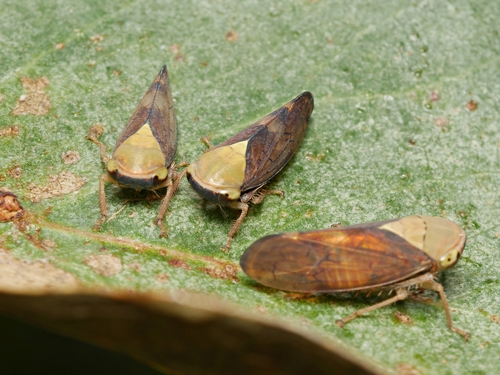
Yellow-headed Leafhopper
Brunotartessus fulvus
With its striking golden crown and remarkable leaping ability, the Yellow-headed Leafhopper is a tiny marvel of the Australian garden. This sap-sucking specialist plays a vital role in local ecosystems, often seen guarded by ants in exchange for its sweet honeydew.
Quick Identification
Size
7–10 mm (0.28–0.39 inches) in length
Colors
Distinctive bright yellow to orange head and thorax; cinnamon-brown to dark tawny forewings; dark, prominent eyes
Key Features
- Broad, pale yellow or orange head and pronotum
- Tawny, wedge-shaped body narrowing toward the rear
- Large, dark eyes positioned on the sides of the head
- Powerful hind legs designed for jumping
When You’ll See Them
Geographic range
Where Does the Yellow-headed Leafhopper Live?
The Yellow-headed Leafhopper is native to the continent of Australia. It is most commonly distributed throughout the eastern half of the country, with high population densities found in the coastal and sub-coastal regions of Queensland, New South Wales, and Victoria. While it is a staple of native bushland, it has successfully transitioned into urban environments, making it one of the most common leafhoppers encountered in Australian suburban gardens.
Basemap © OpenStreetMap contributors
Behavior
The Yellow-headed Leafhopper is a highly active and agile member of the Tartessinae subfamily. Known primarily for its incredible jumping ability, this insect uses its powerful hind legs to catapult itself away at high speeds when it senses a threat. It is a phloem-feeder, utilizing its piercing-sucking mouthparts to extract nutrient-rich sap from the stems and leaves of its host plants. While they are capable of flight, they often prefer to scuttle sideways or jump to move between branches.
This species is frequently observed in a mutualistic relationship with various ant species. As the leafhopper consumes sap, it excretes a sugary substance known as honeydew, which ants harvest for food. In return, the ants act as a personal security detail, protecting the leafhopper from predators like spiders and ladybugs. Though largely solitary, they can be found in small groups on particularly nutritious host plants during the warmer months.
EverydayEarth exclusive
Camera Tips
Capturing the Yellow-headed Leafhopper on a backyard camera requires a specialized approach due to their small size. For the best results, use a camera with a macro lens or a close-focusing distance and mount it approximately 15–30 centimeters (6–12 inches) away from a known host plant. Target the fresh, green stems or the undersides of leaves on Eucalyptus or Acacia saplings, as these are their preferred feeding and resting spots.
Because these insects are strongly attracted to light, you can significantly increase your 'captures' by placing your camera near an outdoor light source or using a camera with a low-intensity LED fill light. At night, they will often land on walls or windows near porch lights, providing a stable, flat surface for clear, focused images. During the day, position your camera to catch the morning sun; the bright yellow head of the leafhopper creates a high-contrast focal point that helps AI motion sensors trigger more reliably.
Since leafhoppers are extremely fast and prone to jumping out of the frame, set your camera to 'Burst Mode' or 'High-Speed Video.' This increases the likelihood of catching the insect in a still pose before it launches away. If you notice ants patrolling a specific branch, that is your ideal camera location, as they are likely tending to a group of leafhoppers nearby.
Similar Species
Species that look similar or are commonly confused with Yellow-headed Leafhopper.
Frequently Asked Questions
Record Yellow-headed Leafhopper at your habitat
Connect a camera to start building your own species record — AI identifies every visitor automatically.