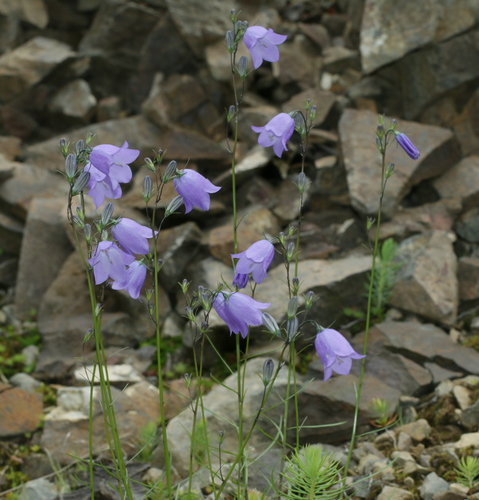
Common Harebell
Campanula rotundifolia
A delicate icon of the northern wild, the Common Harebell charms with its nodding blue blossoms and surprising resilience. These 'bluebells of Scotland' bring a splash of ethereal color to rocky meadows and backyard rockeries alike.
Quick Identification
Size
Stems reach 15-60 cm (6-24 inches) in height; flowers are 12-22 mm (0.5-0.9 inches) long.
Colors
Vivid violet-blue to pale lavender nodding bells; basal leaves are dark green, often turning brown as the plant blooms.
Key Features
- Nodding, bell-shaped violet-blue flowers with five pointed lobes
- Extremely slender, wiry stems that remain upright despite a delicate appearance
- Basal leaves are round or heart-shaped, while upper stem leaves are narrow and linear
- Flowers produce a white, milky sap when the stem or leaves are broken
When You’ll See Them
Geographic range
Where Does the Common Harebell Live?
The Common Harebell is native to the temperate regions of the Northern Hemisphere, with a massive range spanning across Europe, North America, and Northern Asia. In North America, it is widespread from the Arctic Circle down through the northern United States and along the spine of the Rocky Mountains. It is a signature species of the Scottish Highlands and is found across the alpine meadows of Central Europe and Scandinavia.
Basemap © OpenStreetMap contributors
Behavior
The Common Harebell is a resilient perennial that brings a touch of grace to rugged environments. Unlike many delicate-looking flowers, it is surprisingly tough, capable of growing in nutrient-poor soils and withstanding high winds due to its thin, flexible stems. It spends much of the early summer developing its foliage before erupting into a profusion of nodding blue bells from July through September.
Interaction with humans is primarily aesthetic and ecological. In folk tradition, they are often called 'witches' thimbles' or 'bluebells' in Scotland. They serve as a vital nectar source for bees and butterflies. While they do not move around like animals, they exhibit 'turgor movement' to orient their bells away from the wind and rain to protect their pollen, a fascinating behavior to track with a time-lapse camera.
EverydayEarth exclusive
Camera Tips
Capturing the Common Harebell on a backyard camera requires a focus on macro photography and motion stabilization. Because these flowers grow on incredibly thin, wiry stems, they are prone to swaying in even the slightest breeze. Set your camera on a low tripod or a weighted ground mount to get 'eye-level' with the nodding bells. If your AI camera features a macro mode or a close-focus lens, use it to capture the intricate details of the five-petaled corolla and the central style.
For the best lighting, aim for the 'golden hours' of dawn or dusk. The violet-blue pigment of the Harebell can appear washed out in direct, harsh midday sun, but the soft light of the late afternoon makes the colors pop against green grass backgrounds. If you are using a motion-activated camera, be aware that wind can trigger many false positives; adjusting the sensitivity or utilizing a time-lapse mode is often a better strategy for tracking the plant's growth or the opening of new buds over several days.
One of the most rewarding ways to use an AI camera with Harebells is to monitor pollinator interactions. Position your camera about 12-18 inches away from a healthy cluster of blooms. You are likely to capture bumblebees and various solitary bees landing on the bells, which often tip downward significantly under the weight of the insect. Late summer is the peak time for this activity. Ensure your background is clean—a bit of distance between the flower and the foliage behind it will create a beautiful bokeh effect that makes the blue bells the star of your footage.
Similar Species
Species that look similar or are commonly confused with Common Harebell.
Frequently Asked Questions
Record Common Harebell at your habitat
Connect a camera to start building your own species record — AI identifies every visitor automatically.