Spreading Bellflower
Campanula patula
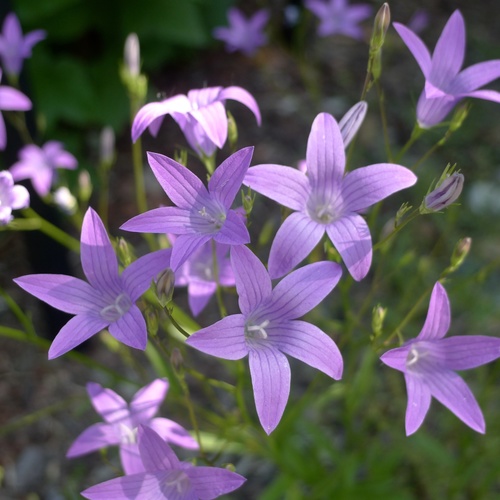
A star among wildflowers, the Spreading Bellflower is famous for its widely flared, lilac petals and delicate, airy stems. This rare beauty brightens woodland edges and traditional meadows throughout the summer months.
Quick Identification
Size
Stems 30-60 cm (12-24 inches) tall; flowers 20-25 mm (0.8-1 inch) in diameter
Colors
Pale violet-blue to lilac petals, occasionally white, with bright green lance-shaped leaves
Key Features
- Star-shaped flowers with deeply divided, pointed petals
- Airy, branching stems that often lean on other plants
- Long, narrow, pointed leaves at the base
- Upright, funnel-shaped blooms that flare wide at the tips
When You’ll See Them
Geographic range
Where Does the Spreading Bellflower Live?
The Spreading Bellflower is native to the European continent, stretching from the temperate regions of the United Kingdom and France across Central Europe into Western Siberia and the Caucasus. While it is widely distributed across Europe, it is increasingly considered rare in its westernmost range, particularly in the UK, where it thrives in localized patches of ancient woodland and undisturbed meadows. It prefers temperate climates and is rarely found in the extreme heat of the Mediterranean or the arctic cold of the far north.
Basemap © OpenStreetMap contributors
Behavior
The Spreading Bellflower is a biennial or short-lived perennial known for its delicate, airy appearance. In its first year, it typically forms a low-lying rosette of leaves, storing energy in its roots. By the second year, it sends up slender, branching stems that can reach over half a meter in height. Because the stems are quite thin, the plant often uses surrounding grasses and shrubs for support, sometimes appearing prostrate or sprawling if no support is available.
Unlike many other members of the Campanula family that have strictly drooping or closed bell-shaped flowers, this species is characterized by its 'spreading' habit. Its flowers face outward or upward, fully opening to the sun to maximize visibility for pollinators. It is a nectar-rich species that plays a vital role in local ecosystems by supporting various species of bees and butterflies during the peak of summer.
EverydayEarth exclusive
Camera Tips
To capture the delicate beauty of the Spreading Bellflower, camera placement is key. Because the stems are thin and prone to swaying in the slightest breeze, use a ground-level stake or a low-profile tripod to keep your camera stable. Position the lens at a slight upward angle to capture the 'spreading' nature of the petals against the sky or a backdrop of foliage, which highlights the star-like geometry of the blooms.
Since this plant is a favorite for pollinators, setting your camera to a 'Photo Burst' or high-speed trigger mode is ideal for catching bees and hoverflies in action. A macro lens or a close-up focal setting will help capture the intricate details of the white pistils against the violet petals. If your camera supports time-lapse photography, this is a fantastic species for capturing the 'circumnutation' (slow dancing movement) of the stems as they grow toward the light over several days.
Lighting is crucial for this species; the pale lilac petals are somewhat translucent. Try to frame your shots during the 'golden hours' of early morning or late afternoon. Backlighting the flowers can create a beautiful halo effect, making the delicate veins in the petals pop. Avoid high-noon sun, as it can wash out the subtle pastel colors of the flower head.
In terms of seasonal timing, focus your efforts from late June through August. This is when the branching lateral stems are most likely to be laden with multiple open flowers. If you are using an AI-powered camera with plant identification, ensure the area around the base of the plant is clear of tall weeds so the camera can clearly see the narrow leaf structure, which helps distinguish it from more common bellflowers.
Similar Species
Species that look similar or are commonly confused with Spreading Bellflower.
Frequently Asked Questions
Record Spreading Bellflower at your habitat
Connect a camera to start building your own species record — AI identifies every visitor automatically.