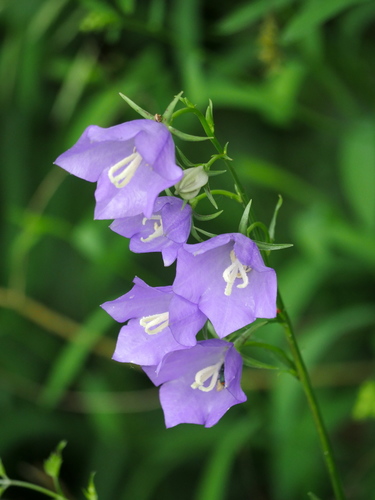
Peach-leaved Bellflower
Campanula persicifolia
A classic of the summer garden, the Peach-leaved Bellflower offers elegant spires of violet or white blooms that seem to dance in the wind. Its peach-like foliage and nectar-rich cups make it a favorite for both photographers and busy pollinators.
Quick Identification
Size
Stems reach 60–100 cm (24–40 inches) in height; leaves are 10–20 cm (4–8 inches) long.
Colors
Brilliant lilac-blue or snowy white flowers; foliage is a deep, glossy emerald green.
Key Features
- Large, open cup-shaped flowers that face outward
- Slender, unbranched stems that give a dainty appearance
- Narrow, lance-shaped leaves resembling the foliage of a peach tree
- Glossy green basal rosettes that remain evergreen in milder winters
When You’ll See Them
Behavior
The Peach-leaved Bellflower is a charming perennial that behaves as a polite wanderer in the garden. Unlike some of its more aggressive cousins, it forms tidy clumps of foliage and sends up elegant, vertical spikes of blooms in early to mid-summer. It is a 'social' plant in the ecological sense, acting as a primary hub for local pollinators. It doesn't spread aggressively by runners but will happily self-seed in open soil, creating a naturalized look over several seasons.
In the wild and in backyards, this species is known for its resilience. It stands tall without the need for staking in most conditions, swaying gracefully in the breeze. While it is largely self-sufficient, it interacts with humans primarily as an ornamental favorite, often found in cottage-style gardens where it bridges the gap between wild meadow plants and formal perennials.
EverydayEarth exclusive
Camera Tips
To capture the stunning beauty of the Peach-leaved Bellflower, place your camera on a short tripod or stake at a height of approximately 24 to 30 inches. This puts the lens at 'eye-level' with the middle of the flowering spike, where the most active blooms reside. Angle the camera slightly upward if you want to capture the sky as a backdrop, or slightly downward to emphasize the pattern of the bell-shaped cups against the green foliage. Because these plants sway in the wind, a faster shutter speed or a 'high sensitivity' setting on your AI trigger is necessary to avoid motion blur during breezy afternoons.
While plants don't require traditional bait, you can 'lure' more action to your camera's field of view by ensuring the Bellflower is the focal point of a pollinator-friendly cluster. Use your camera’s time-lapse mode to record the 'wake-up' cycle of the flowers; many Campanula species show subtle movements as the blooms open fully in response to morning light. Set the interval to one frame every 5-10 minutes from dawn until noon to see the flower spikes come to life.
For the best lighting, position your camera to the south or west of the plant to take advantage of the 'Golden Hour' backlighting. The delicate, translucent petals of the Peach-leaved Bellflower glow beautifully when light passes through them from behind. If your camera has AI animal detection, it may not trigger on the plant itself, so use motion zones focused on the flower heads to capture the wide variety of bees and hoverflies that visit the nectar-rich bells.
During the peak of summer, monitor your camera for heat distortion. If your camera is in a housing, try to place it in a spot that receives afternoon shade while the plant remains in the sun. If you are specifically looking to capture the 'night life' of the garden, keep the camera active; although the flowers are diurnal, you may catch nocturnal moths visiting the white-flowered varieties, which stand out vividly under infrared or low-light sensors.
Similar Species
Species that look similar or are commonly confused with Peach-leaved Bellflower.
Frequently Asked Questions
Record Peach-leaved Bellflower at your habitat
Connect a camera to start building your own species record — AI identifies every visitor automatically.