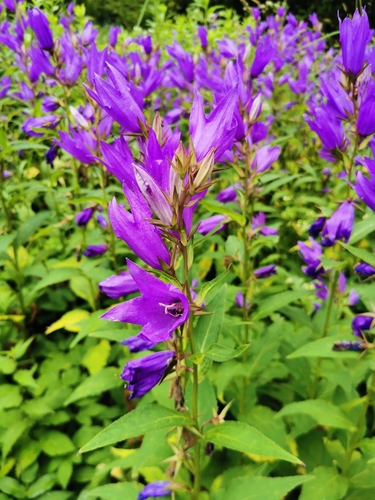
Giant Bellflower
Campanula latifolia
A majestic sentinel of the shade, the Giant Bellflower offers a stunning vertical display of violet blooms that serve as a bustling airport for local pollinators.
Quick Identification
Size
Stems reach 60–120 cm (24–47 in) in height; individual flowers are 4–6 cm (1.5–2.5 in) long.
Colors
Rich violet-blue to pale lavender, occasionally white; deep green, coarse foliage.
Key Features
- Towering unbranched stems
- Large, nodding bell-shaped flowers
- Coarsely serrated, egg-shaped to lanceolate leaves
- Flowers clustered in a long terminal spike.
When You’ll See Them
Behavior
The Giant Bellflower is a robust perennial that commands attention in any landscape it inhabits. Unlike some of its more invasive relatives, this species grows in stately, non-creeping clumps, focusing its energy on vertical growth and a dramatic mid-summer flowering display. It is a favorite among long-tongued bees, particularly bumblebees, which are often seen disappearing entirely into the deep bells to reach the nectar at the base.
As a garden resident, it is hardy and relatively low-maintenance, thriving in the dappled light of woodland edges. While it stays stationary throughout the day, it is highly reactive to environmental shifts, with flowers that sway gracefully in the breeze and petals that slowly unfurl over several days. In the late afternoon, the bell-like structures provide a sheltered microclimate for small insects seeking refuge from evening dew.
EverydayEarth exclusive
Camera Tips
Capturing the Giant Bellflower requires a strategy that blends botanical photography with wildlife monitoring. Because these plants can reach nearly four feet in height, position your camera on a tripod at a 'frog’s eye' view (low and angled upward) to emphasize their stature, or at mid-stem height (about 2-3 feet) to catch the intricate details of the flower interiors. If you are using an AI-powered camera like those from EverydayEarth, set your trigger sensitivity to 'High' to capture the fast-moving bumblebees and butterflies that visit the blooms.
Time-lapse is the secret weapon for this species. Set your camera to take a photo every 30 minutes over a 48-hour period during the peak of July. This will allow you to see the 'unzipping' of the buds into full bells—a fascinating process that is usually too slow for the human eye to appreciate. Ensure your camera is positioned in a spot that receives dappled light rather than harsh, direct midday sun, which can wash out the delicate violet hues and create distracting shadows.
To get the best wildlife shots, focus your lens on a specific cluster of open bells. Since the flowers are deep, insects have to crawl all the way inside, providing a perfect opportunity for 'peek-a-boo' shots of bee bottoms or emerging pollinators covered in white pollen. If your camera has a macro mode or close-focusing capability, place it within 18 inches of the flowers. Be mindful of the wind; on gusty days, use a higher shutter speed to prevent the swaying stalks from blurring your images.
Lastly, consider the 'golden hour.' The purple and blue pigments of the Giant Bellflower are most vibrant during the hour after sunrise and the hour before sunset. During these times, the low-angle light illuminates the fine hairs on the leaves and stems, adding a professional, ethereal quality to your backyard footage. If you are monitoring for herbivores like deer who might nibble the foliage, ensure your camera has infrared night vision capabilities, as they often visit these plants during twilight hours.
Similar Species
Species that look similar or are commonly confused with Giant Bellflower.
Frequently Asked Questions
Record Giant Bellflower at your habitat
Connect a camera to start building your own species record — AI identifies every visitor automatically.