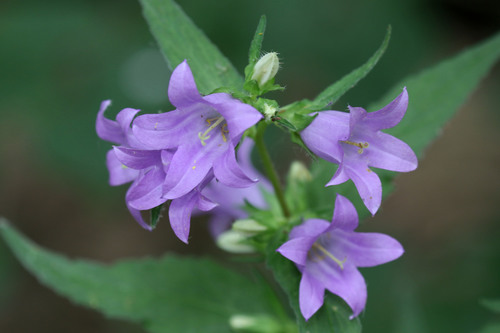
Nettle-leaved Bellflower
Campanula trachelium
With its striking violet bells and rugged, nettle-like foliage, this wildflower is a staple of ancient woodlands and cottage gardens. It is a magnet for bumblebees and a hardy survivor that thrives in the cooling shade of backyard trees.
Quick Identification
Size
Height ranges from 60–100 cm (24–40 inches); spread of 30–60 cm (12–24 inches)
Colors
Flowers are deep violet-blue to pale lilac; stems and leaves are medium to dark green with a rough, bristly texture
Key Features
- Serrated, heart-shaped leaves resembling stinging nettles
- Bell-shaped flowers 3–5 cm long with five pointed lobes
- Angular, bristly stems that are often reddish-tinted
- Flowers arranged in a loose, terminal raceme
When You’ll See Them
Behavior
The Nettle-leaved Bellflower is a hardy perennial that brings a touch of wild elegance to the garden. Unlike some garden cultivars, this species has a rugged, natural look characterized by its stiff, upright growth and hairy foliage. It is a 'civilized' traveler, spreading gently through underground rhizomes and self-seeding in favorable conditions, particularly in the dappled shade of deciduous trees.
This plant plays a vital role in the backyard ecosystem, acting as a primary nectar source for various long-tongued bees. It is especially noted for its relationship with the campanula specialist bees. In a garden setting, it is remarkably resilient, standing tall even after summer storms, and provides a vertical interest that bridges the gap between low-growing groundcovers and taller shrubs.
EverydayEarth exclusive
Camera Tips
To capture the true beauty of the Nettle-leaved Bellflower with your trail camera, placement is everything. Because this plant attracts a high volume of pollinators, position your camera at 'flower height'—roughly 2 to 3 feet off the ground—using a stake or a low tripod. Aim for a distance of about 18 to 24 inches if your camera has a macro or close-focus capability. This allows you to capture the frantic activity of bumblebees as they disappear entirely inside the bell-shaped blooms to reach the nectar at the base.
Lighting can be a challenge in the woodland settings where this plant thrives. To avoid 'blown out' highlights on the purple petals, try to position your camera so the sun is behind it or to the side, rather than pointing directly into a sunbeam. Early morning or late afternoon light provides a soft, golden glow that accentuates the bristly hairs on the stems, which are a key identification feature of the species.
Since plants don't move (unless the wind blows), use your camera’s time-lapse mode to document the blooming cycle. Set the interval to take a photo every hour during the peak of July; you’ll be amazed to see the bells gradually unfurl and lean toward the light. If you are looking to capture insects, use a high-sensitivity PIR (Passive Infrared) setting, though be warned that on windy days, the swaying of the tall stalks may cause frequent 'false' triggers.
For the best results, clear away any tall grasses or stray leaves immediately in front of the lens. These can confuse the autofocus or create blurry foreground obstructions. If you are using an AI-powered camera, the Nettle-leaved Bellflower provides an excellent stationary subject to test your 'Custom Zone' settings, ensuring the camera triggers only when a pollinator enters the specific area of the flower cluster.
Similar Species
Species that look similar or are commonly confused with Nettle-leaved Bellflower.
Giant Bellflower
Has much larger flowers and smooth, long-ovate leaves compared to the jagged, nettle-like leaves of C. trachelium.
Peach-leaved Bellflower
Features very narrow, smooth, grass-like leaves and wide, open cup-shaped flowers.
Clustered Bellflower
The flowers grow in a dense, compact ball at the very top of the stem rather than being spread along it.
Frequently Asked Questions
Record Nettle-leaved Bellflower at your habitat
Connect a camera to start building your own species record — AI identifies every visitor automatically.