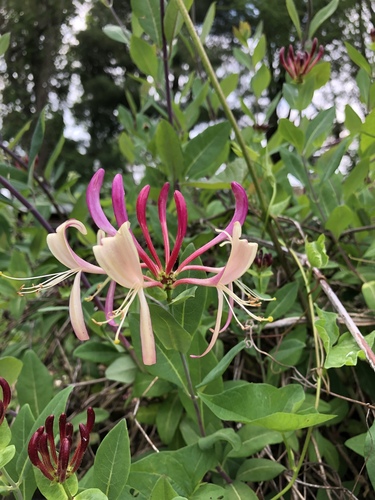
Common Honeysuckle
Lonicera periclymenum
An icon of the evening garden, Common Honeysuckle fills the air with an intoxicating scent and provides a vital vertical habitat for moths, bees, and birds.
Quick Identification
Size
A woody climbing vine that typically grows 5 to 7 metres (16 to 23 feet) in length, though it can reach up to 10 metres in ideal conditions.
Colors
Creamy-white to pale yellow flowers, often flushed with deep pink or red on the outside; dark green oval leaves; translucent bright red berries.
Key Features
- Trumpet-shaped flowers in terminal clusters
- Intense sweet fragrance, especially at night
- Twining woody stems that climb clockwise
- Opposite, non-fused grey-green leaves
- Clusters of glossy red autumn berries
When You’ll See Them
Geographic range
Where Does the Common Honeysuckle Live?
Common Honeysuckle is native to a broad swathe of the temperate Northern Hemisphere, primarily across Europe from southern Scandinavia down to the North African coast of Morocco and Tunisia. It is a quintessential feature of the British and Irish countryside, frequently found in traditional hedgerows and oak woodlands. While its heartland remains Western and Central Europe, it has also established itself in parts of Turkey and the Caucasus, and has been introduced to North America as a popular ornamental garden plant.
Basemap © OpenStreetMap contributors
Behavior
Common Honeysuckle, often called Woodbine, is a vigorous deciduous climber known for its remarkable ability to scramble over hedgerows and scale trees. Unlike many vines that use tendrils, it climbs by twining its entire stem around a support. It is a slow-growing but long-lived plant that eventually develops a thick, shaggy bark on its older, woody base.
The plant exhibits a fascinating nocturnal strategy; its scent production peaks during the evening hours. This 'perfume trail' is specifically designed to attract long-tongued insects, particularly hawk-moths, which are its primary pollinators. In the garden, it acts as a vertical wildlife hub, providing deep nesting cover for small birds and a rich nectar source for a variety of insects.
EverydayEarth exclusive
Camera Tips
Capturing the life cycle of Common Honeysuckle requires a dual approach: focusing on the pollinators by night and the fruit-eating birds by day. To see the plant's nocturnal visitors, position your AI-powered camera approximately 2 feet from a fresh cluster of open blooms. Use a camera with high-quality infrared or low-light sensors, as this is when the spectacular Elephant Hawk-moth is most likely to visit for a nectar feed.
For those interested in time-lapse photography, honeysuckle is an excellent subject. Set your camera to take a frame every 30 minutes during the peak of June. This will allow you to see the 'circumnutation'—the circular searching movement of the young tips as they look for something to climb—and the dramatic unfurling of the trumpet-shaped flowers.
In the late summer and autumn, shift your camera's focus to the berry clusters. These are a favorite of birds like Bullfinches, Thrushes, and Warblers. Mount your camera at a slight downward angle looking onto the berries to capture feeding behavior. Because birds are skittish, ensure the camera is well-camouflaged within the foliage to avoid startling them as they land to forage.
Similar Species
Species that look similar or are commonly confused with Common Honeysuckle.
Frequently Asked Questions
Record Common Honeysuckle at your habitat
Connect a camera to start building your own species record — AI identifies every visitor automatically.