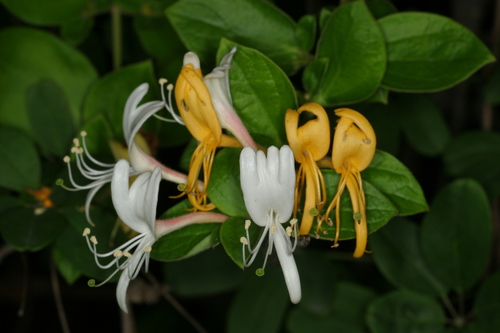
Japanese honeysuckle
Lonicera japonica
Famed for its intoxicating summer scent and delicate white-to-gold blossoms, Japanese honeysuckle is a master climber that bridges the gap between garden beauty and wild invader. It is a bustling hub for hummingbirds and moths, making it a prime location for backyard wildlife watching.
Quick Identification
Size
A woody vine reaching 15–30 feet (4.5–9 meters) in length with stems up to 2 inches (5 cm) thick.
Colors
Flowers are white when blooming, turning creamy yellow as they age; leaves are dark green and glossy.
Key Features
- Pairs of tubular flowers that change from white to golden yellow
- Opposite, oval-shaped leaves with fine hairs on the margins
- Twining reddish-brown or fuzzy stems
- Small, glossy black berries in clusters of two
When You’ll See Them
Behavior
Despite its aggressive growth, it is a significant source of nectar for local wildlife. The flowers are famously fragrant, releasing a heavy, sweet scent that intensifies at dusk to attract pollinators. While humans often enjoy the nostalgic scent of the 'honeysuckle season,' ecologists monitor it closely due to its tendency to create monocultures that reduce biodiversity in backyard and forest ecosystems.
EverydayEarth exclusive
Camera Tips
During the day, set your camera to a fast shutter speed or high-sensitivity motion trigger. This will help you catch the rapid movements of Ruby-throated Hummingbirds and various bumblebee species that frequent the nectar-rich tubes. If your camera supports it, a 4K video setting is ideal for documenting the intricate way insects navigate the long floral tubes to reach the nectar at the base.
Since Japanese honeysuckle is an invasive vine that can grow several feet in a single season, it is also a fantastic subject for long-term time-lapse photography. Set your camera to take one photo every 6 hours from early spring through mid-summer. When played back, you will see the dramatic 'strangling' behavior as the vines twine counter-clockwise around supports and literally leap across open spaces to find new territory. Just be sure to prune any leaves that grow directly in front of the lens, as the wind will move them and trigger thousands of empty 'false' videos.
Similar Species
Species that look similar or are commonly confused with Japanese honeysuckle.
Frequently Asked Questions
Record Japanese honeysuckle at your habitat
Connect a camera to start building your own species record — AI identifies every visitor automatically.