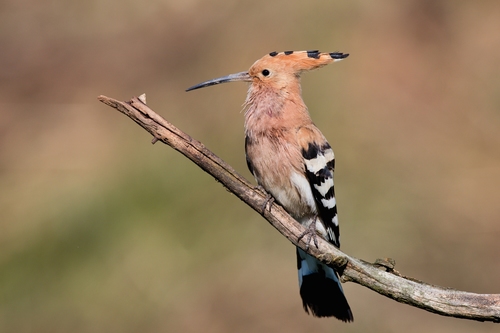
Common Hoopoe
Upupa epops
With its majestic crown and zebra-striped wings, the Common Hoopoe looks like it stepped out of an ancient myth. This striking ground-forager is a favorite for backyard observers across Afro-Eurasia.
Quick Identification
Size
Length: 25–29 cm (10–11 in); Wingspan: 44–48 cm (17–19 in); Weight: 46–89 g (1.6–3.1 oz)
Colors
Cinnamon-pink or sandy-buff body; striking black and white zebra-striped wings and tail; crest feathers tipped with black
Key Features
- Tall erectile crest that fans out when excited
- Long, thin, slightly decurved black bill
- Broad black and white bands on wings
- Undulating 'butterfly-like' flight pattern
When You’ll See Them
Geographic range
Where Does the Common Hoopoe Live?
The Common Hoopoe is an incredibly wide-ranging species found across Europe, Asia, and North Africa. It is a familiar sight from the Mediterranean basin through the Middle East and into the temperate regions of China, with significant populations also residing in Sub-Saharan Africa. While northern populations are highly migratory, spending winters in the tropics, many populations in warmer regions remain as year-round residents.
Basemap © OpenStreetMap contributors
Behavior
The Common Hoopoe is a charismatic and somewhat eccentric bird known for its distinctive 'oop-oop-oop' call. It spends a significant portion of its day on the ground, walking with a rhythmic gait and probing the soil with its long bill for insects. When alarmed or displaying, it dramatically unfurls its crown of feathers into a majestic fan, a behavior that makes it one of the easiest birds to identify from a distance.
While they are solitary foragers, hoopoes are often seen in pairs during the breeding season. They are relatively bold around humans and frequently utilize suburban gardens, parks, and orchards. A fascinating, albeit pungent, behavior of this species is the ability of nesting females and chicks to secrete a foul-smelling liquid from their uropygial gland to deter predators, leading to their historical reputation as 'stink birds' in some cultures.
EverydayEarth exclusive
Camera Tips
To capture the Common Hoopoe on a backyard camera, you must focus on ground-level activity. These birds are dedicated foragers that spend hours probing the dirt for grubs. Place your camera just 12-18 inches (30-45 cm) off the ground, angled slightly downward toward a patch of bare earth or short-cut grass. If you have an area where you've recently turned the soil or a spot near a compost heap, that is prime real estate for a Hoopoe visit.
Since Hoopoes have a unique, erratic 'butterfly' flight pattern and tend to move their heads rapidly while probing, use a fast shutter speed or a high-frame-rate video setting (at least 60fps) to avoid motion blur. If your camera allows for trigger speed adjustment, set it to the fastest possible setting; they can be quite skittish and may fly off at the slightest movement, though they often return to the same foraging spot if undisturbed.
To attract them specifically to your lens, avoid traditional birdseed. Instead, ensure your garden is pesticide-free to encourage large soil-dwelling insects like mole crickets. You can also 'bait' a specific spot by placing a shallow tray of mealworms at ground level. Position the camera facing North or South to avoid lens flare during the morning and evening hours when they are most active. If you know of a nesting site in a hollow tree or an old stone wall, setting up a camera at a respectful distance (10-15 feet) can yield spectacular footage of the adults arriving with beakfuls of larvae.
Similar Species
Species that look similar or are commonly confused with Common Hoopoe.
Frequently Asked Questions
Record Common Hoopoe at your habitat
Connect a camera to start building your own species record — AI identifies every visitor automatically.