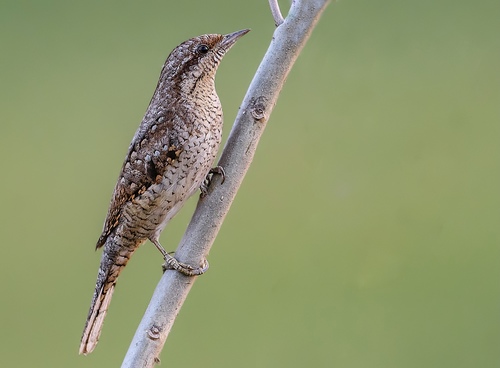
Eurasian Wryneck
Jynx torquilla
The Eurasian Wryneck is a cryptic wonder of the bird world, famous for its snake-like neck movements and intricate, bark-like plumage. A unique member of the woodpecker family, this elusive ant-specialist brings a touch of prehistoric mystery to gardens and orchards.
Quick Identification
Size
Length: 16–17 cm (6.3–6.7 in); Wingspan: 25–30 cm (9.8–11.8 in); Weight: 30–50 g (1.1–1.8 oz)
Colors
Intricate cryptic plumage of grey, brown, and buff with fine dark vermiculations; a prominent dark brown stripe runs from the crown down the back; pale throat with delicate horizontal bars.
Key Features
- Small, cryptically patterned woodpecker with a short, pointed bill
- Unusual ability to rotate neck up to 180 degrees like a snake
- Dark 'medial' stripe extending from the nape down the mantle
- Lacks the stiff, pointed tail feathers of most other woodpeckers
When You’ll See Them
Geographic range
Where Does the Eurasian Wryneck Live?
The Eurasian Wryneck is a widespread species native to the temperate Palearctic, stretching from the British Isles and Western Europe across Russia to Japan. This migratory bird travels thousands of miles each year to spend the winter months in the tropical regions of Sub-Saharan Africa and across Southern Asia, from Iran to Southeast Asia. While they have suffered declines in parts of Western Europe due to habitat loss, they remain a common summer visitor across much of their core Eurasian range.
Basemap © OpenStreetMap contributors
Behavior
The Eurasian Wryneck is a master of camouflage, blending so perfectly with tree bark that it often goes unnoticed until it moves. Unlike its woodpecker relatives, it rarely climbs vertical trunks or drums on wood, preferring to spend its time foraging on the ground or perching horizontally on branches. It is famously known for its bizarre defense mechanism: when threatened, it elongates its neck, twists it slowly from side to side, and emits a loud hissing sound, mimicking a snake to deter predators.
These birds are largely solitary and quiet, except during the early spring when males establish territories with a loud, repetitive, nasal 'quee-quee-quee-quee' call. They are highly specialized ant-eaters, often seen hopping along the ground in short, jerky movements. Despite their shy nature, they can be quite bold when defending a chosen nesting site, sometimes evicting other small birds like tits from their holes.
EverydayEarth exclusive
Camera Tips
To successfully capture the Eurasian Wryneck on your AI camera, you need to focus on their primary attraction: ants. Unlike other woodpeckers, Wrynecks are ground-feeders. Place your camera just 15 to 30 centimeters (6 to 12 inches) off the ground, aiming it toward a known anthill or a patch of bare, sandy soil where ants are active. They are particularly fond of Lasius species (common garden ants), so any area with high ant traffic is a prime location.
Because the Wryneck’s plumage is designed for perfect camouflage against bark and leaf litter, use high-resolution settings and ensure the camera is triggered by even small movements. A fast trigger speed is essential, as their feeding motions are quick and jerky. If your camera supports video or burst mode, use it to capture their unique 'neck-twisting' behavior, which is one of the most interesting behaviors to record.
In a backyard setting, avoid using any pesticides or ant-killers, as this removes their primary food source. You can encourage visits by maintaining a small patch of very short grass or a sand-pit. During the spring migration (April and May), Wrynecks may also investigate nest boxes. Positioning a camera near a box with a 32mm hole in an open, sunny spot can provide a great opportunity to film them as they scout for a home or engage in territorial disputes.
Similar Species
Species that look similar or are commonly confused with Eurasian Wryneck.
Common Nightingale
The Nightingale lacks the Wryneck's dark back stripe and intricate bark-like vermiculations, having instead a plain brown back and a warmer reddish tail.
Lesser Spotted Woodpecker
A similarly small woodpecker, but it features bold black-and-white horizontal barring and spends most of its time on tree trunks rather than the ground.
Meadow Pipit
Also a ground-feeder, but the Pipit has a more slender bill, a streaked breast, and lacks the Wryneck's distinctive 'snake-like' neck flexibility.
Frequently Asked Questions
Record Eurasian Wryneck at your habitat
Connect a camera to start building your own species record — AI identifies every visitor automatically.